The V-Dem 2025 report reveals a world with 91 autocracies versus 89 democracies
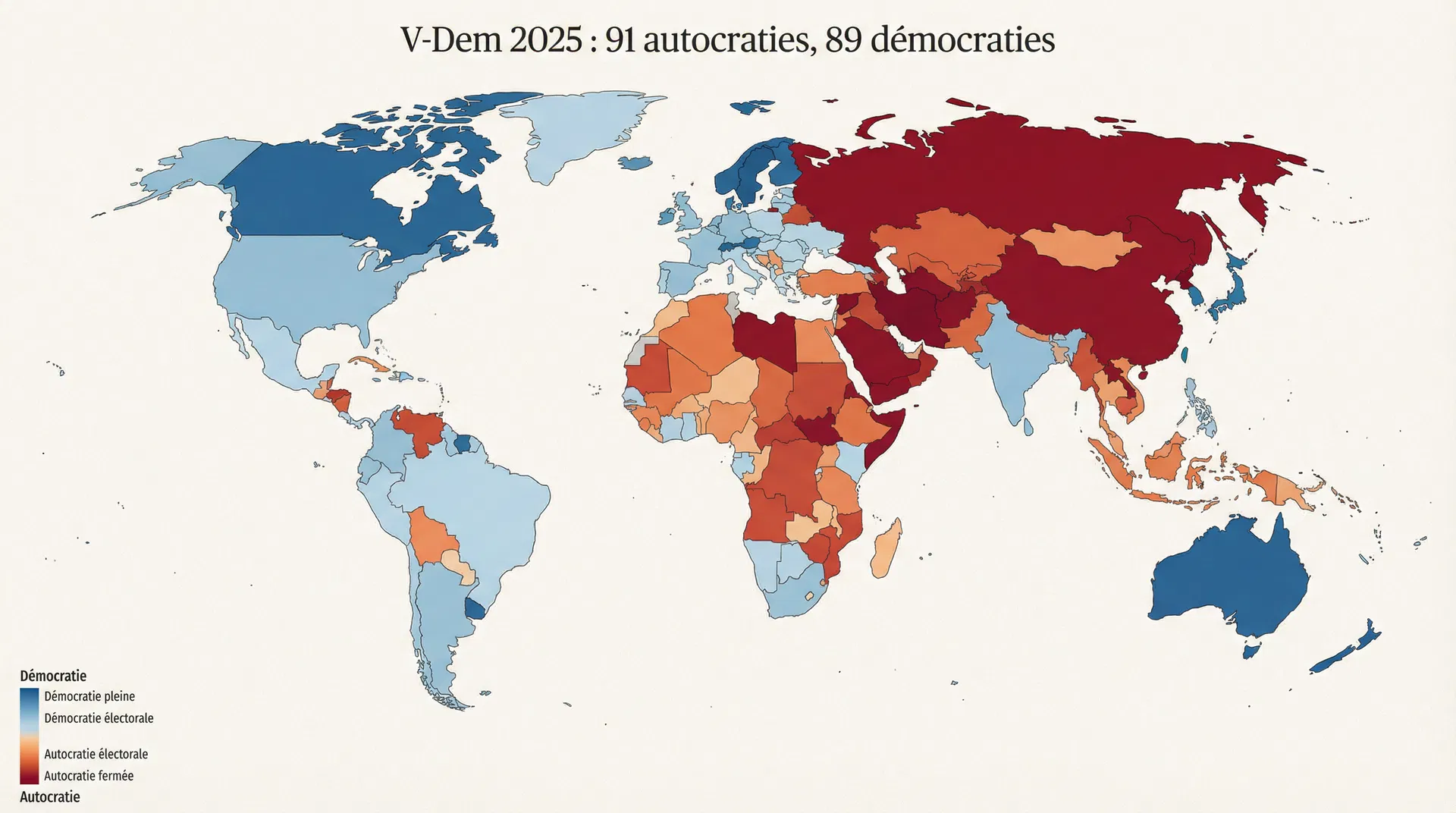
The annual report from the V-Dem Institute (Varieties of Democracy), published on March 4, 2026, documents a shift that political scientists feared: for the first time since the end of the Cold War, the world has more autocracies (91) than democracies (89). Approximately 3.8 billion people now live under an autocratic regime. The average level of democracy worldwide has fallen back to that of 1985.
The Figures
V-Dem is the largest democracy measurement project in the world. It mobilizes over 4,000 experts in 180 countries and produces indices covering hundreds of dimensions: freedom of expression, judicial independence, electoral fairness, press freedom, minority rights.
The 2025 report identifies 42 countries in "autocratization" — a process of gradual democratic backsliding. Among them are established democracies: India (classified as an "electoral autocracy" since 2024), Turkey, Hungary, Tunisia, El Salvador. The phenomenon is not limited to traditionally authoritarian regimes.
Autocratization Through the Ballot Box
The most striking finding of the report is that contemporary autocratization no longer occurs through military coups. It happens through elections. Democratically elected leaders progressively erode checks and balances: weakening judicial independence, controlling media, restricting civic space, modifying electoral rules.
V-Dem identifies a recurring five-step pattern: (1) election of a populist leader, (2) attacks on independent media, (3) weakening of the judiciary, (4) restriction of civil society, (5) modification of electoral rules to perpetuate power. This pattern is found, with variations, in India, Turkey, Hungary, El Salvador, and several West African countries.
The Resistances
The report is not entirely bleak. It also identifies "democratizations" — countries that are progressing. Zambia, Brazil, Moldova, and Poland are cited as examples of democratic rebound after periods of erosion. Zambia, in particular, transitioned from an "electoral autocracy" to an "electoral democracy" after the election of Hakainde Hichilema in 2021.
The Democracy/Autocracy Threshold is a Continuum, Not a Sharp Boundary
The figure "91 versus 89" is striking, but it masks a more complex reality. The boundary between "democracy" and "autocracy" in the V-Dem classification is a threshold on a continuum. Several countries are very close to this threshold — a slight change in score shifts them from one side to the other. The numerical tipping point is symbolically important, but it does not represent a sudden collapse.
Furthermore, the quality of democracy varies enormously among the 89 countries classified as "democratic." Scandinavian democracies and American democracy are in the same category, but at very different levels of quality on the V-Dem indices.
The V-Dem report is a diagnostic tool, not a verdict. It shows a worrying trend that deserves attention and action — not fatalism.