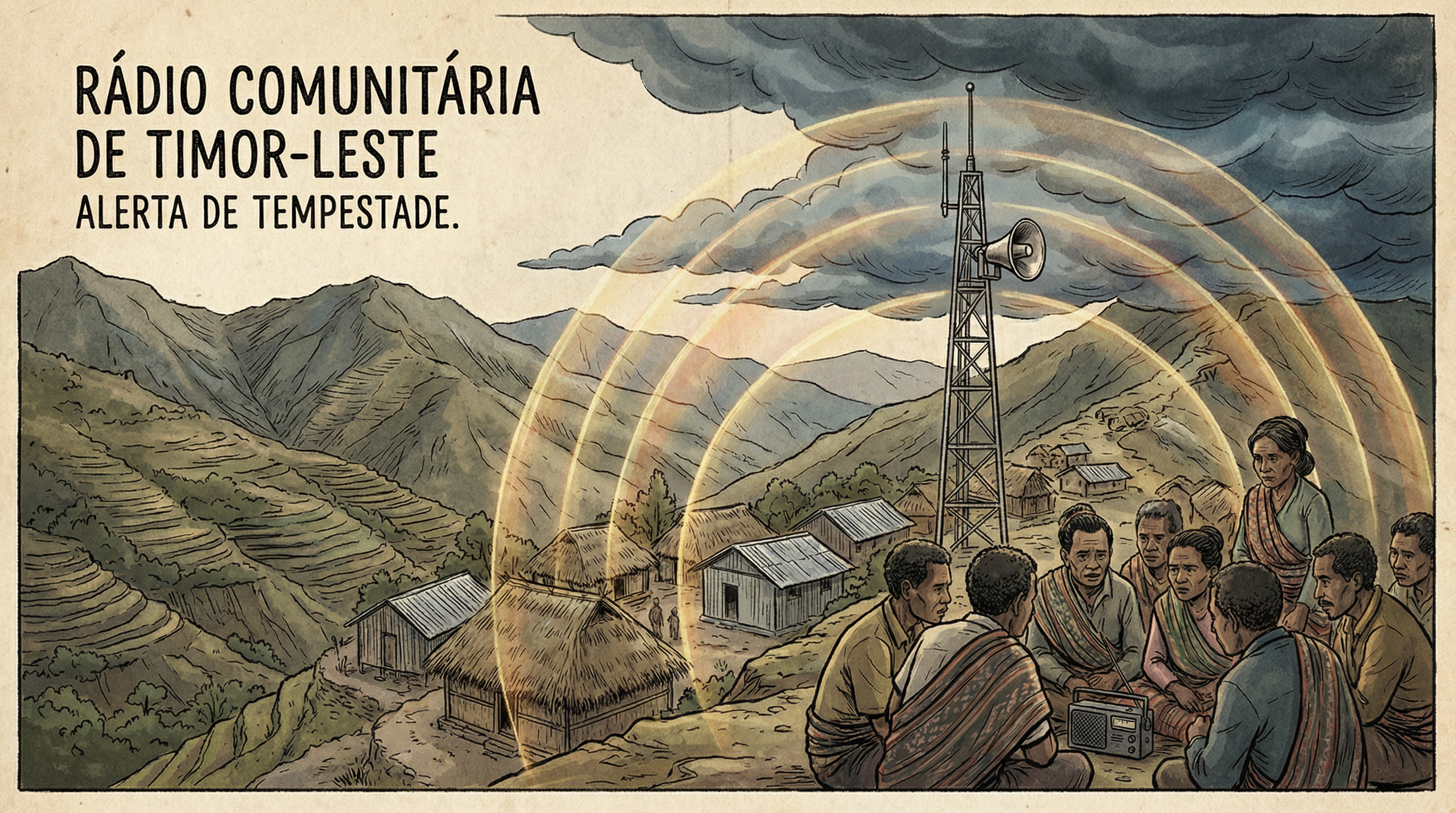
Timor-Leste's Early Warning System: How Radios and Sirens Save Lives Where Digital Fails
| --- | --- | |
|---|---|---|
| Total Population | 1.42 million | [2] |
| Share of Rural Population | 66.7% | [2] |
| Mobile Penetration Rate (connections/population) | 129% | [2] |
| Internet Penetration Rate | 40.4% | [2] |
| Network Coverage in Rural Areas | Weak or non-existent for 56% of households | [1] |
| Main Natural Risks | Floods, landslides, cyclones, tsunamis | [3], [4] |
| Impact of Cyclone Seroja (2021) | 44 deaths, >30,000 households affected | [6] |
Beyond Technology: Trust and Language, the Pillars of Warning
The study conducted in Timor-Leste highlights two human factors that surpass the importance of the technological dissemination channel: trust and language. The effectiveness of a warning is not measured by its technical sophistication, but by its ability to trigger action. However, this action is conditioned by the reception and credibility of the message. Nearly 90% of respondents stated they trusted warning messages, but this trust is not abstract; it is embodied by local leaders. In villages without access to national information, village (suco) and hamlet (aldeia) chiefs are the primary and most credible relays. Their word, delivered in the local dialect and rooted in a shared understanding of the territory, carries a weight that an anonymous SMS or an app notification can never match [1]. This trust is a legacy of the long struggle for independence, during which community networks and traditional structures played a central role in survival and resistance.
The language barrier is the second blind spot of purely technological approaches. Timor-Leste, despite its small size, is a country of great linguistic diversity, with over 16 national languages in addition to the official languages, Tetum and Portuguese. The study revealed that nearly a quarter of households had difficulty understanding past warnings. Among them, 48% found the message "too technical" and 25% pointed out that it was not in their local language [1]. A warning message, even if it reaches its target, is useless if it is not immediately and instinctively understandable. Translation and simplification are not logistical details, but fundamental conditions for the system's effectiveness. This implies training local leaders not only to relay information but also to "translate" it into simple, actionable, and culturally relevant language.
A Global Challenge, Local Solutions: The "Early Warnings for All" Initiative
The case of Timor-Leste is part of a global issue. Launched in 2022 by the United Nations, the "Early Warnings for All" (EW4All) initiative aims to ensure that every person on Earth is protected by an early warning system by 2027 [5]. The required investment, estimated at $3.1 billion over five years, is modest compared to the benefits: a warning issued 24 hours in advance can reduce damages by 30%. The initiative is based on four pillars, and Timor-Leste's experience perfectly illustrates their interdependence:
1. Risk Knowledge: Identifying the most vulnerable areas and populations.
2. Observation and Forecasting: Monitoring threats and anticipating their evolution.
3. Dissemination and Communication: Transmitting the warning effectively and inclusively.
4. Preparedness and Response: Ensuring communities know how to react.
Timor-Leste demonstrates that pillar 3 (dissemination) cannot be separated from pillar 4 (preparedness). The combination of technologies (digital for urban centers, analog for rural areas) and the involvement of local community structures is the only viable response. This hybrid approach is a lesson for other nations facing similar challenges, particularly Small Island Developing States (SIDS), which share high vulnerability to climate shocks and often limited infrastructure. The Comoros archipelago, for example, has implemented a similar system based on Red Cross volunteers and local radio stations to warn of cyclone and flood risks, with proven results in reducing mortality.
Nuances and Limitations: Persistent Challenges
Even with a well-designed dissemination system, significant obstacles remain between receiving the warning and taking protective action. The PreventionWeb study reports that 21% of households did not act after receiving a warning [1]. The reasons given are numerous and reveal the limitations of the warning alone. The lack of safe shelters, the absence of transportation to evacuate, or simply too short a notice (18% of respondents received the warning less than 6 hours before impact) are major barriers. This underscores the need for an integrated approach, where the warning is only the first step in a response chain that must include reception facilities, clear evacuation plans, and regular drills.
Furthermore, the current system struggles to include the most vulnerable. Young people, often equipped with smartphones, are the first to be informed, while the elderly, people with disabilities, and women, who have more limited access to information and mobility, depend on slower and less reliable word-of-mouth communication. To be truly effective, a warning system must be designed from the outset with these groups in mind, using multiple and adapted channels: visual aids, tactile communication, and active involvement of organizations representing these communities. In Bangladesh, the cyclone preparedness program includes volunteers specifically tasked with warning and assisting female-headed households and people with disabilities, a practice that Timor-Leste could draw inspiration from.
Implications and Perspectives: Critiquing Technological Solutionism
Timor-Leste's experience offers a salutary critique of "technological solutionism," the tendency to believe that complex societal problems can be solved by cutting-edge innovations, often at the expense of in-depth analysis of social, cultural, and infrastructural contexts. Researcher Evgeny Morozov, in his book To Save Everything, Click Here, criticizes this "folly of technological solutionism" which, in his view, tends to reframe all complex problems as simple, well-defined problems awaiting an elegant technical solution [8]. The case of Timor-Leste is a perfect illustration of this critique. The problem is not "how to send an alert to a phone," but "how to ensure that an entire community, diverse and unequally connected, understands a risk and acts accordingly."
Technological solutionism often fails because it ignores on-the-ground realities. Multi-billion dollar digital transformation projects fail 70% of the time because they do not account for human and organizational complexity [9]. In developing countries, examples abound: health apps that don't work without a stable connection, educational platforms that widen inequalities due to lack of access to electricity or devices, or AI systems that fail because they are trained on biased data and do not understand local dialects [10].
The real innovation, in the case of Timor-Leste, lies not in inventing a new app, but in the intelligent orchestration of existing, simple, and robust technologies, leveraging the country's most valuable social capital: the trust and cohesion of its local communities. By focusing on impact-based forecasting—that is, communicating not just about the upcoming weather, but about what it will concretely do to homes, crops, and infrastructure—Timor-Leste can transform warnings into genuine decision-making support. The path to complete resilience is still long, but by choosing a pragmatic and inclusive path, this small country offers a great lesson to the rest of the world: to save lives, one must first hear the voice of those one seeks to protect.
---
Sources
- Hearing the call: How Timor-Leste is reaching the 'last mile' with Early Warnings.
- Digital 2026: Timor-Leste.
- Timor-Leste | UNDP Climate Change Adaptation.
- Timor-Leste - Historical Natural Disasters.
- Early Warnings for All.
- Learning from Tropical Cyclone Seroja in Timor-Leste.
- Telecommunications in Timor-Leste.
- Morozov, E. (2013). *To Save Everything, Click Here: The Folly of Technological Solutionism*. PublicAffairs.
- $2.3trillion Wasted Globally in Failed Digital Transformation.
- 5 Real-World Examples of Failed AI Projects in Developing Countries.