In Paris, one in two 6th graders could be in private school by 2035
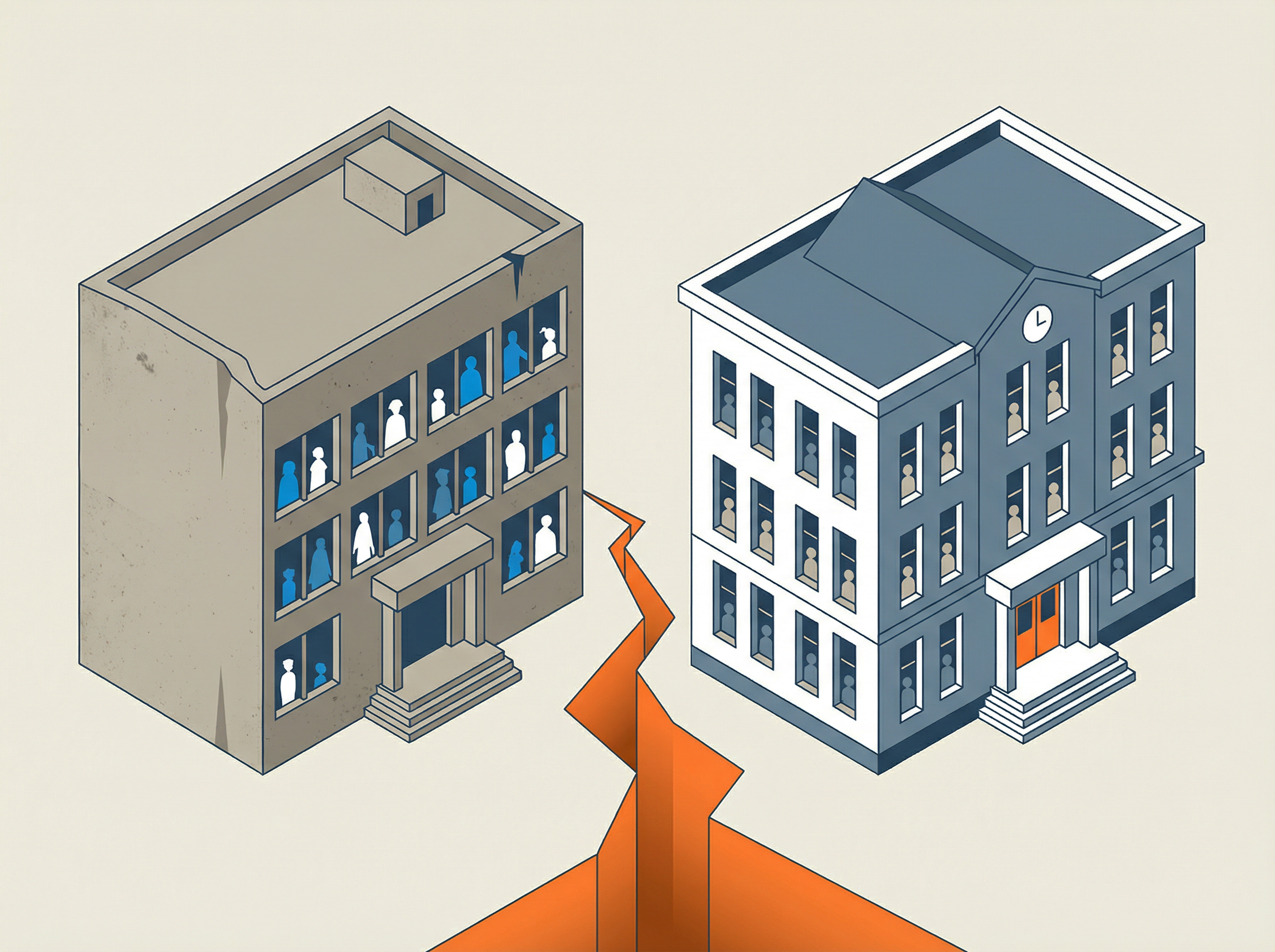
Paris is losing children. Between 2010 and 2024, the number of annual births in the capital fell from 31,440 to 21,484, a decrease of 32%. This demographic drop, more pronounced than at the national level, has direct consequences for schools. But it does not affect public and private schools in the same way. A note from the Institute for Public Policy (IPP), published on March 3, 2026, shows that the subsidized private sector is maintaining its enrollment while the public sector is emptying. If the trend continues, one in two 6th graders in Paris will be enrolled in private school by 2035. [1]
This is not a doomsday scenario. It is a projection based on trends observed between 2020 and 2024, a period during which the private sector's share has already increased mechanically. The problem is not the private sector itself. The problem is that this evolution concentrates students from privileged backgrounds in one sector and students from working-class backgrounds in the other.
35% of 6th graders in private school in Paris, versus 22% in France
The starting point is an already considerable gap. In the 2020 school year, the subsidized private sector enrolled 35.4% of 6th graders in Paris, compared to 21.7% on average nationally. Paris is, along with Rennes and Nantes, one of the cities where the private sector holds the most significant place in the educational landscape.
This gap is explained by history. Paris has a dense network of Catholic private schools, long established in the bourgeois neighborhoods of the west and center. But it is also explained by family strategies. In a city where the school zoning system is perceived as a lottery, private education offers a predictable alternative: parents choose the institution, and the institution chooses its students. [1]
Demographic decline widens the gap between public and private
The IPP note highlights a simple mechanism with profound consequences. When the number of children decreases, the two sectors do not react in the same way. The public sector, constrained by school zoning and the National Education's enrollment management rules, closes classes. The private sector, which has greater flexibility in managing its capacity, maintains its enrollment by broadening its recruitment.
The result is mechanical: the private sector's share increases without the private sector needing to expand. It simply needs to contract at a slower pace than the public sector. Between 2020 and 2024, this is exactly what happened in Paris. The number of students in the public sector decreased faster than in the private sector, and the private sector's share increased by several percentage points. [1]
55% of privileged students in private school in 2024, versus 49% in 2020
The issue is not just quantitative; it is social. IPP data shows that the social composition of the two sectors is diverging. Between 2020 and 2024, the proportion of students from privileged backgrounds in Parisian private schools rose from 49% to 55%. During the same period, the public sector has concentrated a growing proportion of students from working-class backgrounds and immigrant families.
This divergence is not the result of a deliberate policy by the private sector. It is the product of individual family strategies that, when aggregated, produce an effect of segregation. Privileged families, better informed and with sufficient financial means to pay tuition fees (between 1,500 and 3,000 euros per year in Parisian subsidized private schools), turn to private education when they feel the public system does not meet their expectations. Working-class families, on the other hand, do not have this option. [1]
Subsidized private schools: state-funded, free to choose their students
The paradox of the French system is that subsidized private schools are funded by over 70% by the state and local authorities. Teachers are paid by the National Education. Buildings are often subsidized by municipalities. In return, subsidized private institutions are supposed to adhere to national curricula and welcome all students "without distinction."
In practice, the private sector has considerable latitude in recruiting its students. It is not subject to school zoning. It can conduct interviews with families, request school reports, and select applications. This selection, even if informal, results in social sorting. IPP researchers note that Parisian private schools enroll proportionally fewer scholarship students, fewer students with disabilities, and fewer non-native French speakers than public schools. [1] [2]
What is happening in Paris is being prepared in other major cities
Paris is not an isolated case. The IPP note highlights that similar dynamics are at play in other major French cities where the private sector plays a significant role: Lyon, Nantes, Rennes, Bordeaux. The national demographic decline, which has been affecting the entire territory since 2015, will amplify these mechanisms in the coming years.
In Nantes, private schools already enroll over 40% of secondary school students. In Rennes, the proportion is comparable. In Lyon, the situation is particularly marked in the central and western districts, where private schools enroll more than half of middle school students. In Toulouse, the most demographically dynamic metropolis in France, school population growth has primarily benefited the private sector in the affluent southeastern districts of the city. In Marseille, the situation is different: private education is less present (25% of middle school students), but segregation between public middle schools is the strongest in France, according to data from CNESCO (National Council for the Evaluation of the School System).
The media coverage of the IPP note by Le Monde, BFM TV, and Banque des Territoires attests to the resonance of the issue beyond the capital. The Ministry of National Education has not officially responded to the publication, but several public school teacher unions (FSU, UNSA Éducation) have called for a moratorium on class closures in public schools in major cities until a policy of social mixing is implemented. [2] [3]
Levers exist, but require political will
IPP researchers identify several levers to counter this dynamic. The first is to modulate public funding for private schools based on the social diversity of the institutions. A private institution that enrolls a proportion of scholarship students comparable to that of public schools could receive higher funding than one that exclusively selects privileged students.
The second lever is the reform of public school zoning. Several experiments are underway, particularly in Paris, to broaden the recruitment areas of public middle schools and promote social mixing. Preliminary results show that these measures work when accompanied by investment in the quality of the educational offering of the institutions concerned.
The third lever is transparency. The IPP recommends the systematic publication of data on the social composition of public and private institutions, to enable families and elected officials to measure the extent of segregation and evaluate the effectiveness of implemented policies.
The Parisian experiment with multi-middle school zones
Paris has not been inactive. Since 2017, the city has been experimenting with "multi-middle school zones" in four districts. The principle: instead of assigning each student to a single middle school based on their address, families are attached to a zone comprising two or three middle schools. Assignment takes into account the social composition of the zone to balance profiles among institutions.
Preliminary results, evaluated by the IPP and DEPP (Directorate for Evaluation, Prospective, and Performance), show a measurable reduction in social segregation in the concerned zones. The proportion of disadvantaged students in the most privileged middle schools increased by 5 to 8 percentage points. The flight to private education did not increase in these zones, contrary to initial fears.
However, the experiment remains limited to four zones out of Paris's twenty districts. Its extension requires political will, which the 2026 municipal elections will test. Private school parent associations and some elected officials oppose it, citing families' freedom of choice.
The cost of segregation: what studies say
School segregation is not just an issue of equity. It has a measurable economic cost. The work of economist Éric Maurin (PSE) has shown that the concentration of students in difficulty in the same institutions produces a negative "peer effect": the academic results of vulnerable students deteriorate more when they are grouped together than when they are distributed in mixed institutions.
The OECD estimates that France is one of the developed countries where social origin most strongly predicts academic results. PISA 2022 results show that the performance gap in mathematics between students from the most favored quarter and those from the least favored quarter is 113 points in France, compared to 93 points on average in the OECD. Segregation between institutions is one of the mechanisms that produce this gap.
Conversely, countries that have reduced school segregation have improved their overall results. Poland, after a structural reform of its school system in 1999 that delayed student selection, saw its PISA scores increase by 40 points in ten years. Denmark, which has no significant subsidized private sector, shows a social gap of 73 points, well below the French level. These comparisons do not prove a direct causal link, but they show that school diversity and performance are not incompatible.
A societal choice, not a technical problem
School segregation between public and private is not a demographic fatality. It is the result of institutional rules (public funding of private education, school zoning, recruitment freedom) and family strategies that, combined, produce social sorting. The decline in birth rates merely accelerates a pre-existing mechanism.
The question posed by the IPP note is political: does France accept that its school system evolves towards a de facto separation between a public sector accommodating the most vulnerable students and a state-funded private sector reserved for the wealthiest families? In Paris, if nothing changes, this separation will be effective by 2035. In other major cities, it will follow.
The debate is not new. But the demographic decline gives it unprecedented urgency. Every year that passes without reform reinforces the separation mechanism. Classes closed in the public sector will not reopen when birth rates rise, if they do. Families who have chosen private education will not spontaneously return. The window of action is narrowing.
The IPP note does not advocate for the abolition of subsidized private education. It poses a question of coherence: if the state finances a school sector, it is legitimate for it to demand from that sector a contribution to social diversity proportional to the funding received. This requirement, which already exists in law (Article L. 442-1 of the Education Code requires subsidized private institutions to welcome "all children without distinction"), is not applied in practice. Making it effective does not require new legislation. It requires political will.
Sources
- https://www.ipp.eu/actualites/baisse-demographique-et-dynamiques-public-prive-vers-une-segregation-scolaire-accrue-dans-les-grandes-villes/
- _blank
- noopener