Healthcare Renunciation in Europe: From 0.2% in the Netherlands to 22% in Greece
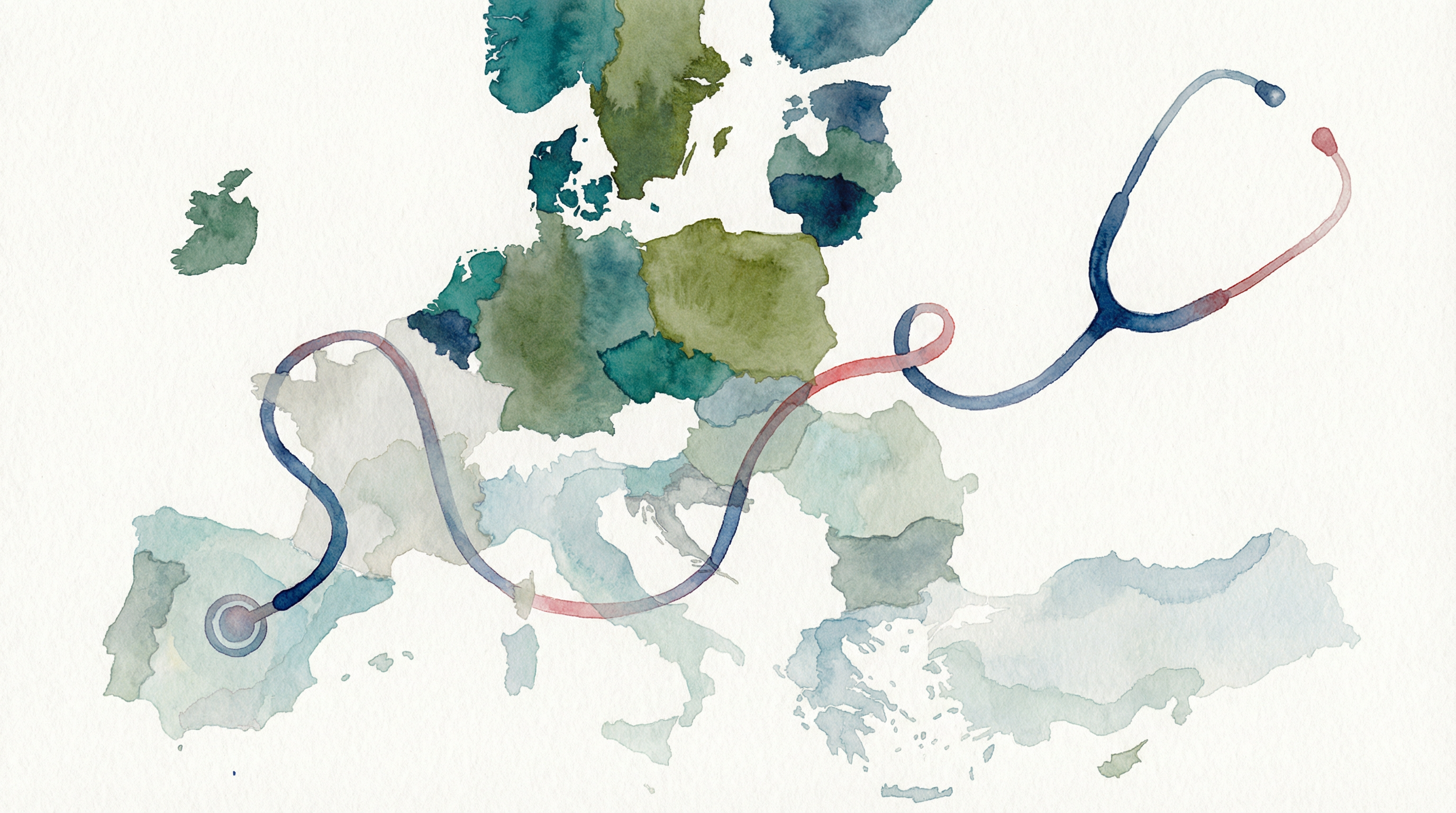
In August 2025, Eurostat published updated data on unmet medical needs in the European Union. The average figure, 3.6% of the adult population in 2024, seems modest. But it conceals considerable disparities between countries. In Greece, 21.9% of inhabitants report having foregone a medical examination or treatment during the past year. In Finland, 12.4%. In Estonia, 11.2%. In France, the official rate is around 3%. [1]
These figures, which measure healthcare renunciation due to financial reasons, distance, or waiting times, are among the most revealing indicators of the true state of a healthcare system. They tell a story that per capita healthcare expenditure statistics do not show: that of people who, when faced with a health problem, decide not to consult a doctor.
France, a Seemingly Good Performer
France's rate of 3% places it among European countries with the lowest healthcare renunciation. This result is explained by universal health coverage, the complémentaire santé solidaire (CSS) for the most modest incomes, and a primary care network that is still dense compared to other European countries.
However, this Eurostat figure, based on a harmonized self-reported survey (EU-SILC), captures only part of the phenomenon. National surveys, which ask more detailed questions adapted to the local context, yield very different results. According to a NèreS survey published in 2025, 34% of French people report having foregone healthcare in the past twelve months. The discrepancy with the Eurostat figure is 1 to 10. [2]
How can such a discrepancy be explained? The methodology. The EU-SILC survey asks if the person had an unmet medical need for one of the following three reasons: cost, distance, waiting time. National surveys pose the question more broadly: have you foregone consulting a doctor, undergoing examinations, purchasing medication, or following a treatment? This more open wording captures forms of renunciation that the European survey does not measure, particularly renunciation due to discouragement over delays, lack of awareness of one's rights, or self-exclusion.
Medical Deserts: A Problem of Distribution, Not Numbers
France has approximately 230,000 active doctors, a figure slightly increasing after years of stagnation. The problem is not the total number of doctors, but their distribution across the territory. Data from the DREES (Direction de la recherche, des études, de l'évaluation et des statistiques) show that the density of general practitioners varies from one to three times between the best-equipped departments (Paris, Hauts-de-Seine, Bouches-du-Rhône) and the least well-equipped (Eure, Mayenne, Ain).
Specialists are even more concentrated. In ophthalmology, the average waiting time for an appointment exceeds 80 days nationally, and reaches 120 days in some rural departments. In dermatology, waiting times are comparable. For patients without supplementary health insurance covering additional fees, foregoing specialized care is often a direct consequence of these waiting times and costs.
Greece, Ten Years After the Crisis: Scars on the Healthcare System
The Greek case is the most extreme in the European Union. The 21.9% rate of unmet medical needs is a direct result of the austerity policies imposed between 2010 and 2018. During the debt crisis, public health expenditure was reduced by over 40%. Hospitals closed, doctor and nurse positions were eliminated, and health coverage was withdrawn from hundreds of thousands of long-term unemployed individuals.
Ten years after the end of the adjustment program, the Greek healthcare system has not recovered. Per capita health expenditure remains below the European average. The number of doctors per inhabitant is high (Greece trains many doctors), but a significant proportion practices in the private sector, inaccessible to the most modest patients. The result is a two-tier system where access to care directly depends on income.
Finland, an Unexpected Case
The Finnish rate of 12.4% is surprising for a Nordic country renowned for the quality of its public services. The explanation lies in waiting times within the public healthcare system. Finland has a decentralized healthcare system, managed by municipalities, which suffers from significant disparities between urban and rural areas. In large cities (Helsinki, Tampere), access to care is rapid. In rural municipalities in the north and east, waiting times to consult a general practitioner can exceed several weeks.
The social and health services reform (sote-uudistus), which came into force in 2023, transferred responsibility for health services from municipalities to 21 "well-being services counties" (hyvinvointialue). The objective is to reduce inequalities in access by pooling resources. The first results, expected in 2026-2027, will indicate whether this structural reform succeeds in reducing waiting times in underserved areas.
OECD Confirms the Trend: Healthcare Renunciation is Increasing Everywhere
The OECD's Health at a Glance 2025, published in November 2025, confirms that healthcare renunciation is on the rise in most developed countries. The OECD average increased from 2.7% in 2019 to 3.4% in 2024. The increase is attributed to three factors: rising healthcare costs (out-of-pocket expenses, additional fees), longer post-Covid waiting times, and a shortage of healthcare professionals in certain specialties. [3]
The OECD report notes that renunciation of dental care is even higher than renunciation of medical care: 4.6% on average in the EU in 2024, with peaks of 15% in some countries. Dental care, less well covered by social protection systems, is often the first type of care that modest households forego.
Dental Care: The Most Widespread Renunciation
Renunciation of dental care is systematically higher than renunciation of medical care. Eurostat measures an average rate of 4.6% in the EU in 2024, but national surveys yield much higher figures. In France, according to the DREES, 17% of adults report having foregone dental care in the past year. The rate reaches 30% among people living below the poverty line.
Dental care accumulates all obstacles: high out-of-pocket expenses despite the "100% Santé" reform (which only covers basic prostheses and crowns), long waiting times, and territorial distribution even more unequal than that of general practitioners. The density of dental surgeons varies from 1 to 5 between the best-equipped departments (Paris, Alpes-Maritimes) and the least well-equipped (Eure, Mayenne).
The health consequences of foregoing dental care are documented: untreated oral and dental pathologies worsen cardiovascular diseases, diabetes, and systemic infections. They also have social consequences: poor dental health is a factor in employment discrimination and social exclusion.
12% of French GDP for Health, but Persistent Access Inequalities
Healthcare renunciation is an outcome indicator, not a means indicator. A country can spend a lot on health and still have a high renunciation rate if expenditures are poorly distributed. France spends 12% of its GDP on health, one of the highest rates in Europe, but access inequalities persist between territories, social categories, and types of care.
The challenge for health policies is to shift from a logic of means (how many doctors, how many hospital beds) to a logic of results (how many people actually access the care they need). Eurostat data, despite their methodological limitations, offer a valuable point of comparison. They show that healthcare renunciation is not inevitable: some countries (Netherlands, Austria, Germany) manage to maintain rates below 1%, thanks to a combination of universal coverage, waiting time regulation, and territorial distribution of healthcare professionals.
The Netherlands: A Model That Works, at What Cost?
The Netherlands boasts one of the lowest healthcare renunciation rates in Europe: 0.2% in 2024. This result is based on a mandatory health insurance system with a generous care package, strict regulation of waiting times (Treeek standard: maximum 4 weeks for a specialist consultation, 7 weeks for a surgical procedure), and a dense network of general practitioners who act as gatekeepers.
The cost is high: the Netherlands spends 10.2% of its GDP on health, with an annual deductible of 385 euros per insured person, which weighs on modest households. But the result is there: almost the entire population accesses the care they need within reasonable timeframes.
France spends more (12% of GDP) for a less favorable outcome in terms of effective access. The difference lies less in the amount of expenditure than in its distribution: France allocates a disproportionate share of its health expenditure to hospitals (36% versus 28% in the Netherlands) and underinvests in primary care and prevention. Healthcare renunciation is a symptom of a system that prioritizes curative over preventive care, and hospitals over community-based medicine.
Teleconsultation: Partial Solution or False Promise?
Teleconsultation exploded during Covid. In France, the number of teleconsultations reimbursed by the Assurance maladie increased from 80,000 in 2019 to 13.5 million in 2020, before stabilizing around 4 million per year in 2024-2025. It is presented as a solution to medical deserts and healthcare renunciation.
The data temper this optimism. The DREES showed in 2024 that teleconsultation users are predominantly urban, young, educated, and already well-covered by the healthcare system. The populations that forego healthcare the most (elderly, precarious individuals, residents of rural areas without digital coverage) are also those who use teleconsultation the least. The tool reduces waiting times for those who already have access to the system, without reaching those who are excluded from it.
Teleconsultation also does not replace clinical examination. For chronic pathologies, dermatological problems, joint pain, remote diagnosis remains limited. General practitioners surveyed by the DREES estimate that 30 to 40% of teleconsultations require a complementary physical examination. Teleconsultation is a useful complement, not a substitute for a territorial network of healthcare professionals.
Healthcare renunciation is a silent indicator. It doesn't make headlines. It doesn't provoke demonstrations. But it measures, year after year, the distance between the promise of a universal healthcare system and the reality experienced by patients. In France, 3.1% of the adult population reports foregoing necessary care. Behind this figure are 1.6 million people who, each year, do not receive care due to lack of means, time, or available doctors. Eurostat data show that other European countries perform better, with comparable or lower expenditures. The question is not to spend more, but to spend better.
Sources
- https://ec.europa.eu/eurostat/web/products-eurostat-news/w/ddn-20250820-2
- _blank
- noopener