Race Relations in the United States: A Growing Divergence Between Lived Experience and Public Perception
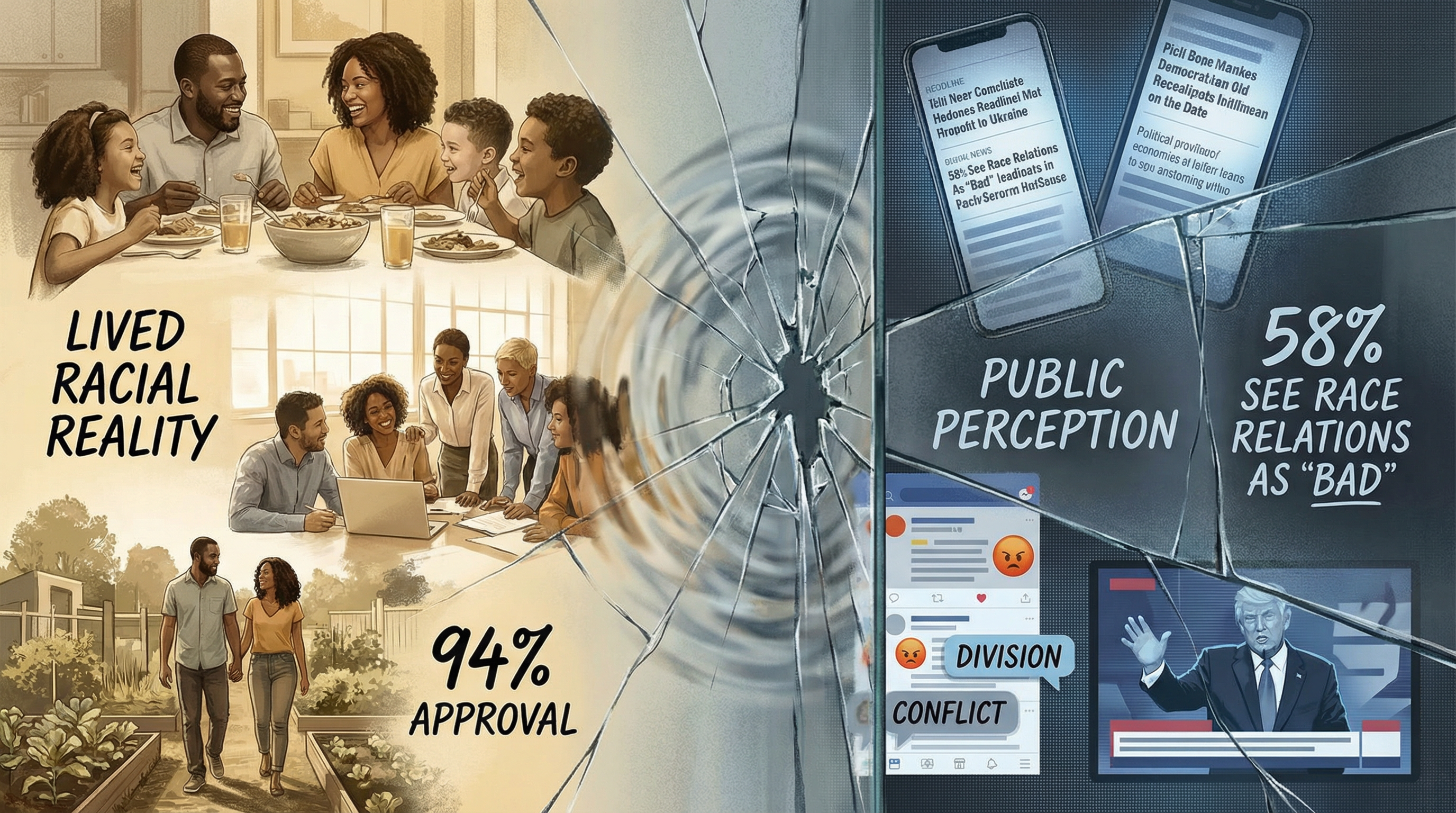
In 1958, during the height of institutionalized segregation, the idea of a marriage between a white and a Black person was anathema to the overwhelming majority of Americans: only 4% approved. That year, the case of Richard and Mildred Loving, an interracial couple from Virginia, began its long legal journey that would culminate, nine years later, in the landmark Supreme Court decision Loving v. Virginia, invalidating all laws prohibiting interracial marriage. By 2021, more than half a century after this foundational decision, support for such unions had reached a peak of 94%, a near-consensus symbolizing a social transformation of exceptional speed and depth. Yet, this tangible progress in the intimate sphere coexists with pervasive pessimism. A 2019 Pew Research Center poll revealed that nearly six in ten Americans (58%) judged the overall state of race relations in their country to be bad.
How can a society be both massively integrated in its most personal relationships and perceive itself as dangerously divided along racial lines? This apparent contradiction is the starting point of a fundamental investigation jointly conducted by the Brookings Institution and the Gallup institute in February 2026. Their findings highlight a growing and concerning gap between the lived reality of interpersonal interactions, which are increasingly fluid, and public perception, largely shaped by a media and political ecosystem that thrives on narratives of conflict and polarization.
93% of Americans Approve of Interracial Marriage, But 88% of Black People Judge the Justice System as Unfair
The 2026 Brookings-Gallup study confirms, with recent data, an underlying trend observed for decades: in private and professional spheres, Americans of all backgrounds interact with increasing ease. A majority of respondents report having interracial friendships, and daily contact at work is described as the norm.
The acceptance of interracial marriage is the most powerful and symbolic marker of this evolution. In 2021, the approval gap between white Americans (93%) and non-white Americans (96%) became statistically insignificant. Generational barriers, once massive, have considerably eroded: while 18-29 year olds are almost unanimous (98%), their elders aged 50 and over are not far behind (91%), a spectacular leap from the 27% approval in that same age group in 1991. Geographically, the South, a historical bastion of resistance to integration, has finally joined the national consensus with 93% favorable opinions.
This picture of ongoing interpersonal integration, however, crashes against a wall of radically different perceptions as soon as one addresses power structures and systemic equity. A 2016 Pew Research Center study illustrates this gap strikingly. While 88% of Black people believe the justice system does not treat them fairly, only 66% of white people share this view. The gap is equally pronounced regarding treatment by the police (84% of Black people perceive inequity versus 50% of white people) or access to credit and housing (66% versus 43%).
For Andre M. Perry, one of the study's authors at Brookings, it is imperative to distinguish two realities evolving at different speeds: the data show that when people think about their daily interactions—when they go to school, to work, when they make friends—they can cross racial lines quite easily. It's when we talk about policies around the distribution of goods that it becomes a point of friction.
Each Believes Their Personal Experience is Exceptionally Positive: The Pluralistic Ignorance Bias
This disconnect between a predominantly positive personal experience and a negative collective perception is largely explained by a cognitive bias well-known to social psychologists: pluralistic ignorance. This concept, defined as early as the 1930s, describes a situation where most members of a group privately reject a norm or belief, while mistakenly thinking that other members accept it. For fear of isolation or deviance, they publicly conform to this supposed norm, thereby creating and reinforcing a collective illusion.
Applied to race relations, this mechanism is particularly powerful. An individual may have cordial and respectful relationships with neighbors or colleagues of a different background, but, exposed to a constant stream of images of protests, riots, or inflammatory political discourse, they come to believe that their personal experience is an exception and that the social norm is division and hostility. They thus dramatically underestimate the number of their fellow citizens who share their peaceful daily reality.
In the digital age, this cognitive bias is supercharged by the very nature of communication platforms. Social media algorithms are designed to maximize user engagement. However, numerous studies have shown that engagement is strongly correlated with emotion, particularly indignation, fear, and anger. The content that goes viral is not that which represents nuance or normality, but that which stages conflict, excess, and caricature of the other.
White Median Wealth Remains Ten Times Higher Than Black Median Wealth
The optimism born from these positive personal interactions must be tempered by two powerful and well-documented phenomena: affective polarization and the persistence of structural inequalities.
Affective polarization describes a situation where hostility towards the opposing political camp becomes stronger than adherence to one's own camp. It is no longer so much a disagreement on the substance of public policies as an identity-based animosity. In the United States, where partisan affiliation is strongly correlated with racial identity, this political polarization fuels a form of social division that often overlaps and merges with the racial dimension.
Furthermore, one must not confuse the improvement of interpersonal relations with the disappearance of systemic inequalities. The fact that individuals from different groups mutually appreciate each other does not change the massive disparities that persist in wealth—the median wealth of a white family is nearly ten times higher than that of a Black family—income, access to quality education, health outcomes, or treatment by the criminal justice system. These inequalities are the product of a long history, of segregation, and of discriminatory public policies whose effects are felt across generations.
The Real Challenge: Reforming Structures Without Denying Interpersonal Progress
The main implication of this divergence between perception and reality: the narrative of a society on the brink of racial civil war, fueled by a segment of the political spectrum and by a media model that monetizes conflict, is an oversimplification. It does not account for the considerable progress made in the sphere of interpersonal relations, which constitute a valuable social capital and a foundation upon which to build.
Recognizing this progress is not a form of complacency or denial of remaining problems. On the contrary, it is an essential condition for making the correct diagnosis and, consequently, for acting effectively. The main challenge for 21st-century America is no longer that of a predominantly intolerant population refusing contact, as was the case sixty years ago. The challenge is more subtle and complex: to reconcile increasingly peaceful daily interactions with political and economic structures that continue to generate and perpetuate deep inequalities on racial grounds.
This distinction is fundamental for public action. It suggests that the most effective levers may no longer lie solely in the fight against individual prejudices—a battle largely won in hearts and minds—but in the courageous and ambitious reform of public policies that create disparities in housing, education funding, taxation, access to healthcare, or criminal justice. The path to progress lies in the ability to hold both ends of the chain: celebrating integration without ever forgetting justice.
Sources
- Gallup (2021). U.S. Approval of Interracial Marriage at New High of 94%.
- Pew Research Center (2019). How Americans see the state of race relations.
- Perry, A.M., Kendi, I.X. & Wootson, C.R. Jr. (2026). Americans are not as divided by race as it seems. Brookings Institution.
- Pew Research Center (2016). On Views of Race and Inequality, Blacks and Whites Are Worlds Apart.
- Iyengar, S. et al. (2019). The Origins and Consequences of Affective Polarization in the United States. Annual Review of Political Science.