The Plastic Time Bomb Under Asia's Agricultural Lands
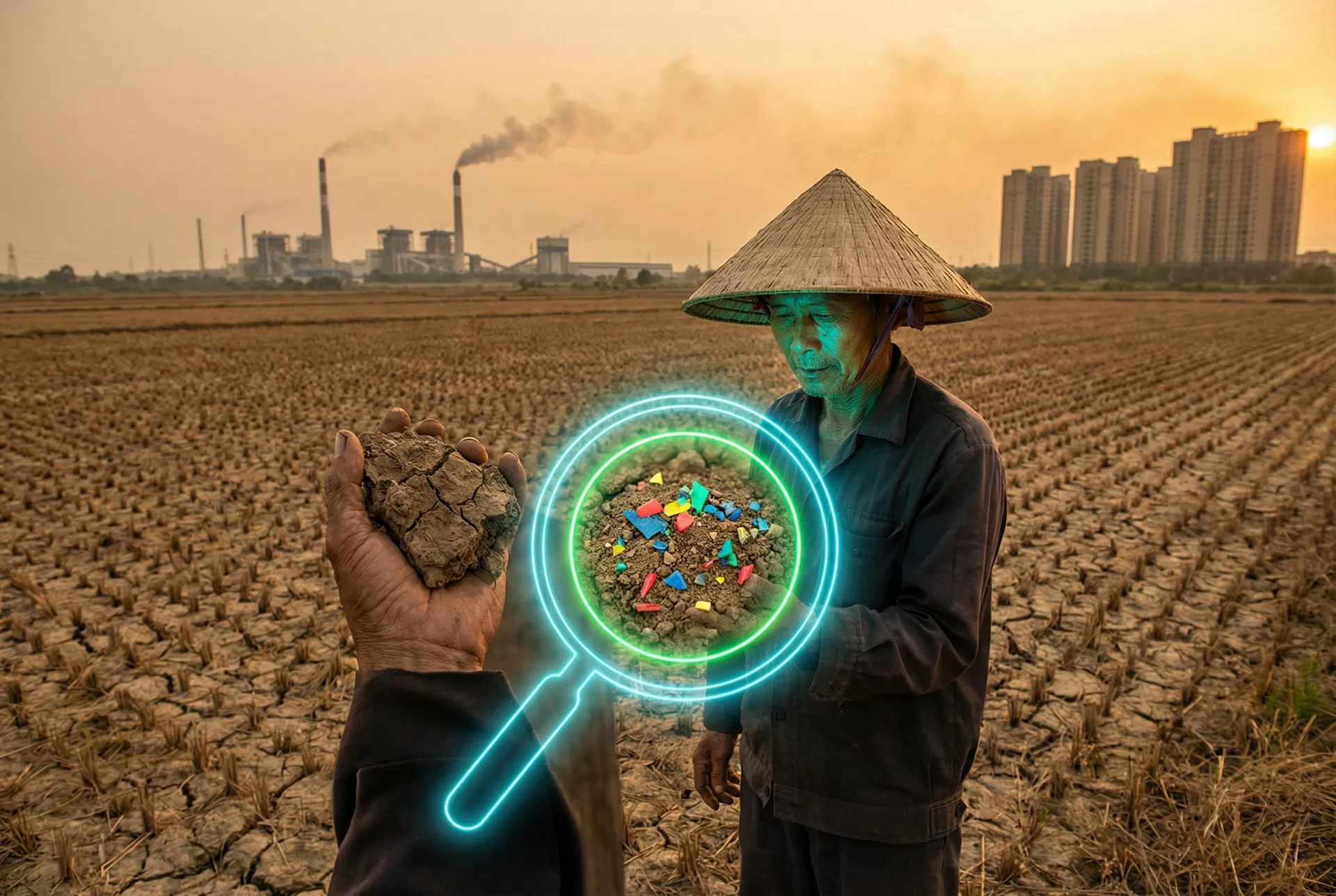
The food security of billions of individuals relies on the health of agricultural soils. However, a silent and largely underestimated threat looms over Asia's fertile lands: plastic pollution. Far less visible than the waste accumulating in the oceans, this terrestrial contamination could have even more devastating consequences for natural environments and human health. From mulching films to irrigation pipes, including fertilizer and pesticide packaging, modern agriculture has become deeply dependent on this material, creating an environmental and health time bomb whose effects are only just beginning to be measured.
12.5 million tons of plastic dumped into soils each year
Asia is the epicenter of plastic use in agriculture, accounting for nearly half of global consumption [1]. Each year, 12.5 million tons of plastic products are directly introduced into agricultural environments, a figure to which is added 37.3 million tons from food packaging that often ends up in the environment, burned or buried near fields [1]. The range of "plasticultures" is wide: mulching films, greenhouse films, irrigation pipes and tubes, bags, nets, or seedling trays. Contrary to a common perception focused on oceans, agricultural soils act as a much more significant receptor of microplastics [1]. It is estimated that terrestrial microplastic contamination is 4 to 23 times higher than that of oceans.
Mulching films, of which China is the largest global consumer with over 64% of the total, are one of the most significant sources of this pollution [4]. A study conducted in Xiangtan, China, highlighted an average concentration of 4,377 microplastic particles per kilogram of soil, with peaks reaching 12,292 particles/kg [3]. Notably, the study showed that the use of these films quadruples the concentration of microplastics in cultivated plots [3]. Global demand for these films is expected to increase by 50% by 2030, suggesting an exponential worsening of contamination [1].
The multiple facets of soil degradation
The presence of plastic debris, from the largest fragments to invisible nanoplastics, profoundly alters the fundamental properties of the soil. An expert assessment by the Food and Agriculture Organization of the United Nations (FAO) published in 2025 confirmed that this pollution modifies the physical structure, chemical composition, and microbiological balance of agricultural lands [2].
Physically, plastic fragments reduce air and water circulation, increase soil compaction, and affect its structural stability. Chemically, they can alter the pH and cation exchange capacity of the soil. But it is the impact on soil life that is most concerning. Soil fauna, composed of organisms like earthworms, springtails, and mites, is severely affected. These soil engineers, essential for aeration and fertility, see their habitat and survival threatened. Studies show that microplastics can cause intestinal blockages and internal damage to these organisms, reducing their growth, reproduction, and lifespan [5]. The disruption of these faunal communities has direct consequences on the structure and overall health of the soil, decreasing its ability to sequester carbon and recycle nutrients.
The hidden chemical threat of agricultural plastics
Beyond physical pollution, plastics introduce insidious chemical contamination. To give them properties of flexibility, durability, or fire resistance, manufacturers add a multitude of chemicals, such as phthalates and bisphenol A (BPA). These substances are not chemically bound to the base polymer and can migrate out of the plastic to spread into the soil, water, and air, especially under the effect of heat and UV rays.
Research has confirmed the presence of phthalates and BPA in agricultural soils, where they can accumulate at worrying levels [6]. These compounds are known endocrine disruptors, capable of interfering with the hormonal systems of animals and humans, even at very low concentrations. Their presence in agricultural soils opens the way for their absorption by crops, adding a new layer of toxicological risk to the food chain. Furthermore, microplastics act as sponges, attracting and concentrating other pollutants already present in the soil, such as pesticides or heavy metals, creating toxic cocktails whose synergistic effects are still poorly understood.
From soil to plate: a health risk becoming clearer
The fragmentation of plastics into micro and nanoplastics, combined with the release of chemical additives, poses an increasingly documented health risk. These particles can be absorbed by plant roots and end up in the edible parts of crops, from leafy vegetables to fruits. Studies have already detected the presence of microplastics in a variety of foods intended for human consumption, such as apples, carrots, and lettuce.
Even more worrying, traces of these particles have been identified in human feces and even placentas, confirming their ingestion and circulation in the body [1]. Research conducted on rats has demonstrated the transmission of nanoplastics from mother to fetus, raising serious questions about the long-term effects on neurological development and reproductive health [1]. Chronic exposure to a cocktail of microplastics and chemical additives via food represents an emerging field of research, but its initial conclusions call for strict application of the precautionary principle.
Political responses to be strengthened and harmonized
Given the scale of the problem, several Asian countries are beginning to implement regulatory frameworks, although their effectiveness remains uneven and their application often incomplete.
In China, the world's largest user of agricultural plastics, measures have been taken to address the problem of residual mulching films. National standard GB/T 35795-2017 has set quality and recyclability requirements for these films. New regulations aim to hold manufacturers accountable by obliging them to set up collection and recycling systems, and to encourage farmers to return used films. In September 2025, Shanghai implemented a new plastic restriction policy, illustrating a gradual increase in awareness.
India has also adopted ambitious legislation, the Plastic Waste Management Rules, which prohibit many single-use plastics. However, on-the-ground enforcement remains very difficult, particularly in the agricultural sector where collection and recycling infrastructures are almost non-existent and where raising awareness among millions of small farmers is an immense task.
At the regional level, the Association of Southeast Asian Nations (ASEAN) has adopted a Framework of Action on Marine Debris, which includes measures to reduce plastic leakage from land. However, a specific and binding strategy for agricultural soil pollution is still lacking. Countries like Thailand and Vietnam have their own national roadmaps for plastic waste management, but agriculture is not always a priority. Harmonizing standards, sharing technological innovations, and implementing extended producer responsibility (EPR) systems at the regional level are essential steps for effective action.
Building a post-plastic agriculture: a multifaceted endeavor
Ending dependence on plastic in agriculture will not happen overnight. It requires a profound transformation of practices, supported by innovation and ambitious public policies. The "6R" model (Refuse, Redesign, Reduce, Reuse, Recycle, and Recover) offers a comprehensive roadmap.
- Refuse and Reduce: The first step is to question the necessity of each plastic product. Agroecological practices, such as using organic mulches (straw, compost) instead of plastic films, or mechanical weeding instead of chemical weeding (whose containers are plastic), can drastically reduce the amount of plastic entering farms.
- Redesign: The plastic industry must be pushed to design more durable products that are easier to collect and recycle, and above all, free of toxic additives. The development of truly biodegradable polymers under soil conditions (and not just in industrial composters) is a crucial research avenue. Clear standards and reliable labels are necessary to guide farmers.
- Reuse and Recycle: The lifespan of agricultural plastics must be extended. Deposit or rental systems for certain equipment (such as harvest crates) can be considered. Above all, it is imperative to invest massively in recycling channels adapted to agricultural plastics, which are often soiled by soil and plant residues. This involves setting up accessible collection points for farmers and developing effective cleaning and treatment technologies. Pilot projects in Asia show that it is possible to transform used mulching films into second-life plastic pellets, usable for manufacturing other objects.
- Recover: For plastic waste that cannot be avoided or recycled, recovering its energy value can be a last resort solution, provided that energy recovery facilities comply with strict environmental standards to avoid transforming soil pollution into air pollution.
Innovation is a major key. Alternatives such as biodegradable mulching films made from corn or potato starch are beginning to be commercialized. Research is also exploring the creation of durable composite materials from agricultural waste (rice straw, coconut husks) and recycled plastics, offering a dual solution for waste management. Simultaneously, the development of agroecological practices, which restore soil health and reduce dependence on external inputs, is fundamental to building a truly robust and sustainable food system.
The contamination of agricultural soils by plastic in Asia is a silent crisis that threatens the foundations of food security and public health in the world's most populous region. Inaction is no longer an option. It is imperative to act decisively to decontaminate soils, prevent all future pollution, and transition to agriculture that feeds people without poisoning the earth. This will require close coordination between governments, scientists, the agrochemical industry, farmers, and citizens to defuse this time bomb before it explodes.