Ocean Acidification, the Silent Threat of Carbon
The global ocean absorbs nearly a third of the carbon dioxide (CO2) emitted by human activities, a process that profoundly alters its chemical composition. Since the beginning of the industrial era, this massive absorption has led to an increase in the acidity of surface waters by nearly 30%, initiating a cascade of consequences for marine life and the ecosystems that depend on it. This phenomenon, distinct from but intrinsically linked to climate change, is progressing silently and constitutes a fundamental alteration of the planet's functioning.
The Ocean's Chemistry is Transforming
The ocean acts as a planetary buffer. By absorbing atmospheric carbon dioxide (CO2), it limits the extent of the greenhouse effect. However, this ecosystem service comes at a direct cost: the modification of marine chemistry. When CO2 dissolves in seawater, it reacts to form carbonic acid (H2CO3), an unstable molecule that quickly releases hydrogen ions (H+). It is the increase in the concentration of these ions that measures the acidity of a solution. Data collected over several decades confirm a fundamental trend: the average pH of ocean surface waters has dropped from about 8.2 in pre-industrial times to 8.1 today. As the pH scale is logarithmic, this apparent decrease of 0.1 units represents an increase in acidity of about 26 to 30%.
This transformation is not uniform. Cold waters, particularly in polar regions like the Arctic and Southern Oceans, absorb more CO2 than warm waters, making them especially vulnerable to rapid acidification. Furthermore, natural phenomena such as upwelling, which brings deep, naturally CO2-rich and more acidic waters to the surface, can locally exacerbate the problem. This is particularly the case along the west coasts of continents, such as in California or Peru, where these upwellings create zones of particularly pronounced acidity.
The most direct consequence of this increased acidity is the reduced availability of carbonate ions (CO3²⁻). These ions are a fundamental building material for a multitude of marine organisms that use them, through the process of calcification, to build their shells and skeletons. In the presence of a greater number of hydrogen ions (H+), carbonate ions tend to bind with them to form bicarbonate ions (HCO3⁻), making them less available for biomineralization. In the most acidic conditions, seawater can even become corrosive to existing limestone structures, threatening their integrity and causing them to dissolve.
The Ocean's Builders on the Front Line
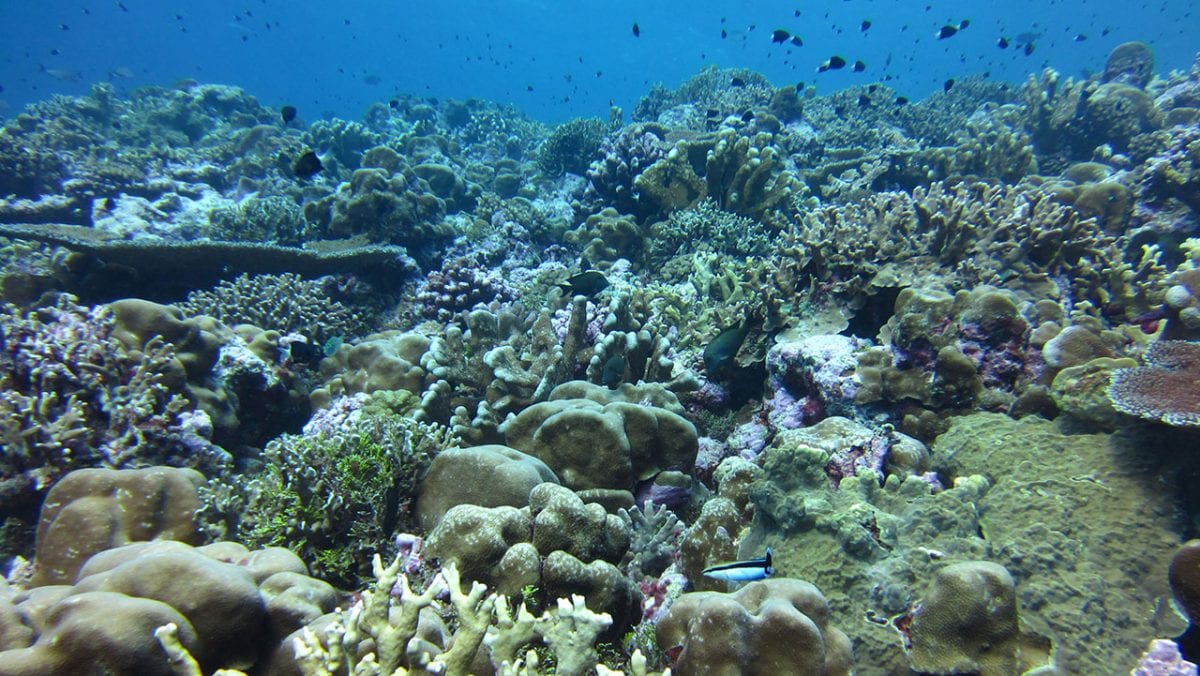
Calcifying organisms are the first victims of this chemical change. Corals, the architects of reefs that shelter nearly a quarter of marine biodiversity, are particularly affected. The reduction of carbonate ions in the water slows their growth and weakens their skeletons, making them more fragile in the face of storms and erosion. This situation is aggravated by warming waters, which cause coral bleaching—the expulsion of symbiotic algae (zooxanthellae) that nourish the coral and give it its color. In April 2024, the U.S. National Oceanic and Atmospheric Administration (NOAA) officially confirmed the fourth global coral bleaching event, a phenomenon spanning the three major ocean basins. Acidification acts as an additional stressor, compromising the ability of corals to recover from these bleaching episodes. The loss of coral reefs represents a direct economic threat to millions of people dependent on tourism and fishing, and weakens essential natural protection for coastlines.
Beyond corals, many other links in the food chain are threatened. Pteropods, small pelagic snails nicknamed "sea butterflies," are an essential food source for species like salmon, mackerel, and herring. Their thin shells made of aragonite, a particularly soluble form of calcium carbonate, can dissolve in more acidic waters, with direct consequences for their survival. Laboratory experiments have shown visible corrosion of their shells after only a few days in acidity conditions predicted for the end of the century. Their decline could cause a collapse of the fish populations that feed on them.
Bivalve mollusks, such as oysters, mussels, and clams, which form the basis of many commercial fisheries, also struggle to build their shells. Studies in hatcheries on the northwest coast of the United States have shown that local acidification events have caused massive mortalities of oyster larvae, unable to develop their first shell. The oyster industry in Washington State, for example, has suffered significant economic losses, forcing it to invest in water chemistry monitoring systems to adapt its practices. Crustaceans, like crabs and lobsters, as well as echinoderms, such as sea urchins and starfish, also depend on the calcification process and see their development, metabolism, and reproduction affected.
Cascading Impacts on Ecosystems
The effects of acidification are not limited to calcifying organisms. The change in seawater pH disrupts many biological and physiological processes. Research has highlighted behavioral alterations in some fish species. For example, the sense of smell of clownfish larvae can be affected, reducing their ability to detect predators or locate a favorable habitat, which decreases their chances of survival. Other studies suggest that acidification can interfere with the neurological functions of some fish by acting on GABA-A receptors, which can cause abnormal behaviors, greater risk-taking, and reduced anxiety in the face of threats.
These disruptions propagate throughout the entire food web. The scarcity of pteropods and other organisms at the base of the food chain can lead to a decrease in resources for their predators, affecting commercially important fish stocks and marine megafauna, such as whales. The degradation of coral reefs, in turn, means the loss of a vital habitat for thousands of species, as well as the disappearance of a natural barrier that protects coastlines from erosion and waves. The ecosystem services provided by these habitats, from fishing to tourism, are thus directly threatened, with economic and social repercussions for the coastal communities that depend on them. It is estimated that coral reefs provide goods and services worth several hundred billion dollars per year.
An Uncertain Future and Tipping Points
Scientists are concerned about the interaction of acidification with other stressors related to climate change, such as ocean warming and deoxygenation (the decrease in oxygen concentration in the water). This "deadly trio" acts in synergy, and their combined effects are often more severe than the sum of their individual impacts. For example, an organism struggling to maintain its internal balance in warmer, more acidic water will need more oxygen, even as it becomes scarcer. This multiplication of stressors is pushing marine ecosystems toward tipping points, beyond which rapid and potentially irreversible changes could occur.
Earth's history offers us warnings. Past acidification events, such as the Paleocene-Eocene Thermal Maximum about 56 million years ago, have been associated with mass extinctions of deep-sea benthic organisms. However, the current rate of acidification, directly linked to anthropogenic emissions, is estimated to be at least ten times faster than anything the planet has experienced in tens of millions of years. This speed leaves little time for species to adapt through evolution, increasing the risk of widespread extinctions.
Economic Consequences for Coastal Communities
Ocean acidification is not just an ecological problem: it has direct economic repercussions for communities that depend on the sea. The global shellfish industry (oysters, mussels, clams) represents a market of more than $7 billion per year. However, mollusk larvae are particularly vulnerable to acidification during their first hours of life, when they form their first shell. On the American Pacific Northwest coast, oyster hatcheries have suffered massive larval mortalities since 2007, directly linked to upwellings of more acidic deep water. The Whiskey Creek Shellfish Hatchery in Oregon lost up to 80% of its production in some years before implementing a real-time pH monitoring system to adjust its operations.
Coral reefs, threatened by both warming and acidification, generate an estimated $36 billion in revenue per year through tourism, fishing, and coastal protection. In Australia, the Great Barrier Reef alone contributes A$6.4 billion to the national economy and supports 64,000 jobs. The degradation of these ecosystems also affects the food security of hundreds of millions of people in tropical regions. According to the FAO, about 3 billion people worldwide depend on seafood as their main source of animal protein. In the Pacific Islands, fish accounts for up to 90% of the protein intake in some communities. The decline in fish stocks linked to the degradation of coral habitats and the disruption of marine food chains could worsen food insecurity in these already vulnerable regions.
IPCC Projections and Avenues for Action
Scientific projections, particularly those from the Intergovernmental Panel on Climate Change (IPCC), paint a worrying future. Based on different socio-economic scenarios (SSPs), climate models anticipate a continuation of acidification during the 21st century. In a very high emissions scenario (SSP5-8.5), the average pH of surface waters could drop to 7.7-7.8 by 2100. Such a level of acidity has not been seen on Earth for millions of years and would likely be associated with profound ecosystem changes. Conversely, a low-emissions scenario (SSP1-2.6), which assumes ambitious climate action in line with the Paris Agreement goals, would limit the pH drop and stabilize acidification by the end of the century, although a return to pre-industrial conditions is not feasible for several centuries.
The inertia of the ocean system means that even if CO2 emissions were stopped today, acidification would continue for decades before slowly beginning to reverse. The current and future consequences of this phenomenon underscore the urgency of reducing global carbon dioxide emissions. This is the only long-term solution. At the same time, local adaptation strategies are being explored to mitigate the impacts. These include restoring seagrass meadows and mangroves, which can capture carbon and create refuges of alkalinity for marine life. Research is also looking into the assisted selection of corals or mollusks more resistant to acidity. However, scientists agree that these local measures, while useful, cannot replace global action on the source of the problem: anthropogenic CO2 emissions.
Sources
- [1] NOAA. Ocean Acidification, noaa.gov
- [2] NOAA. 4th Global Coral Bleaching Event, noaa.gov
- [3] EPA. Effects of Ocean and Coastal Acidification on Marine Life, epa.gov
- [4] IPCC AR6 WG1. Chapter 5 - Global Carbon and Biogeochemical Cycles, ipcc.ch