Mouse Brains Frozen at -196°C Successfully Revived: A World First
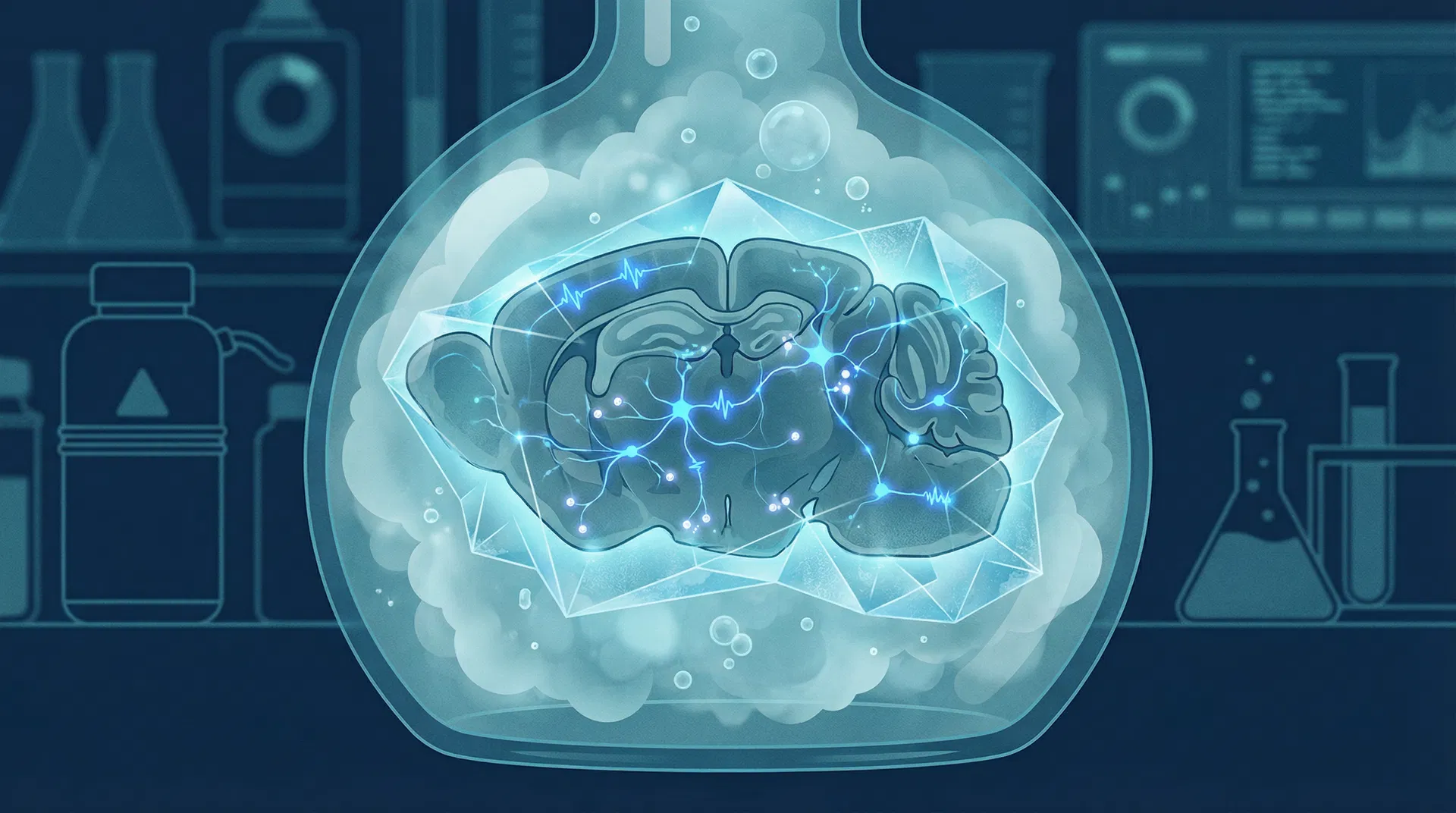
# Mouse Brains Frozen at -196 °C Successfully Reactivated: A World First
Pillar : Science & Technology | Format : In-depth article | Date : March 20, 2026
---
Mouse brain slices frozen at -196 °C for seven days have been successfully reactivated, retaining measurable neuronal activity, intact synaptic membranes, and long-term potentiation capacity — the cellular mechanism underlying learning and memory. This is reported by a study published on March 3, 2026, in the Proceedings of the National Academy of Sciences by Alexander German and his colleagues from the University of Erlangen-Nuremberg, Germany. For the first time, researchers have demonstrated that brain function can survive complete cryopreservation and thermal rewarming.
The Barrier No One Had Crossed
Cryopreservation of biological tissues has been an established technique for decades. Sperm, oocyte, and embryo banks rely on it. Stem cells, corneas, and heart valves are preserved at low temperatures in medical facilities worldwide. But the brain resisted. Its structural complexity — billions of neurons connected by trillions of synaptic connections, organized into networks whose emergent properties constitute thought, memory, and consciousness — made it particularly vulnerable to freezing damage.
The main problem is physical: when tissue is cooled slowly, the water it contains forms ice crystals. These crystals, as they grow, puncture cell membranes, displace organelles, and rupture synaptic connections. The result is irreversible mechanical destruction of the neuronal microarchitecture. Previous studies had shown that isolated neurons could survive freezing, but not that functional neural networks — capable of processing information and forming memories — could be preserved and reactivated.
Vitrification: Transforming Water into Glass
German's team circumvented the problem of ice crystals by using a technique called vitrification. The principle is simple in theory, but difficult in execution: cool the tissue fast enough so that water molecules do not have time to organize into crystals. Instead of solidifying into ice, the water freezes into an amorphous, glassy state — like glass. The molecules are immobile but disorganized. There are no crystals, hence no mechanical damage.
To achieve this, the researchers first treated the brain slices with a solution of cryoprotectants — molecules that penetrate cells and partially replace water, lowering the freezing point and facilitating vitrification. The slices were then immersed in liquid nitrogen at -196 °C. The cooling rate must be extremely fast — on the order of thousands of degrees per minute — to achieve vitrification before crystals can form.
The slices were maintained at -150 °C in a vitreous state for durations ranging from ten minutes to seven days. Reactivation was then performed in warm solutions, with a rewarming rate also controlled to prevent crystal formation when passing through the critical temperature zone.
Intact Membranes, Preserved LTP: The Five Key Results That Make the Difference
After reactivation, the team subjected the slices to a battery of tests. The results are detailed in the article published in PNAS:
Structural Integrity: Microscopy showed that neuronal and synaptic membranes were intact. The connections between neurons — the synapses — had not been ruptured by freezing.
Metabolic Activity: Mitochondrial activity tests revealed no significant metabolic damage. Mitochondria, the cells' powerhouses, functioned normally after reactivation.
Electrical Activity: Electrical recordings of neurons showed responses to electrical stimuli that were "close to normal," with moderate deviations compared to unfrozen control cells. The neurons reactivated, transmitted signals, and responded to stimulations.
Long-Term Potentiation (LTP): This is the most significant result. Hippocampal neural pathways showed long-term potentiation after reactivation — the synaptic strengthening that constitutes the cellular mechanism of learning and memory. It wasn't just that the neurons "lived" after freezing: they were capable of modifying their connections in response to activity, which is the basis of brain plasticity.
| Test | Result |
|---|---|
| Neuronal membrane integrity | Intact ✅ |
| Synaptic membrane integrity | Intact ✅ |
| Mitochondrial activity | Normal ✅ |
| Electrical response to stimuli | Close to normal (moderate deviations) ✅ |
| Long-term potentiation (LTP) | Present ✅ |
| Tested preservation duration | Up to 7 days ✅ |
350-Micrometer Slices, Not an Entire Brain: What the Study Does Not Prove
Alexander German is the first to precisely frame his results. The study was conducted on brain slices 350 micrometers thick — thin sections, not an entire brain. These slices naturally degrade within a few hours after reactivation, which limited observations to a short time window. The results do not allow concluding that an individual's memory or identity could be preserved and restored.
Mrityunjay Kothari, a mechanical engineer at the University of New Hampshire who studies cryopreservation, acknowledges that the study "advances the state of the art," but adds that "applications such as long-term preservation of large organs or entire mammals remain well beyond the capabilities of this study." The gap between mouse brain slices and an entire human brain is immense, both in terms of mass (a few milligrams versus 1,400 grams) and architectural complexity and vascularization.
The cryoprotectants used are also toxic at high concentrations. Their uniform diffusion into a large organ is an unresolved problem. And the cooling rate required for vitrification is difficult to maintain beyond a certain tissue thickness.
Realistic Medical Applications
While human cryonics remains science fiction, the medium-term medical implications of this research are concrete and significant.
Organ Preservation for Transplantation. Organs intended for transplantation — heart, liver, kidney, lung — degrade rapidly after retrieval. The heart must be transplanted within 4 to 6 hours. The liver can wait 12 to 24 hours. These time windows limit transportation possibilities and donor-recipient matching. A functional cryopreservation technique would allow the creation of organ banks, transport of organs over long distances, and improvement of transplant logistics. Thousands of lives could be saved each year.
Brain Protection During Trauma. During cardiac arrest or severe traumatic brain injury, the brain suffers damage related to ischemia — the interruption of oxygen supply. Brain cooling techniques are already used in neurosurgery to slow metabolism and protect neurons during procedures. Vitrification opens up the prospect of deeper and more durable protection.
Neuroscientific Research. The ability to preserve functional brain slices for several days, or even weeks, opens up new research avenues. Experiments requiring several days of preparation could be conducted on preserved tissues, rather than on animals sacrificed for each experiment.
The Broader Context: Whole Organ Cryopreservation
German's study is part of a broader movement in cryobiology research. In 2023, a team from the University of Minnesota successfully rewarmed cryopreserved rat organs without damage, using a magnetic nanoparticle rewarming technique. In 2024, researchers from the University of Cambridge published results on the cryopreservation of human corneas with maintenance of endothelial function.
The cryopreservation of entire mammalian brains remains a distant goal. A study published in March 2026 on bioRxiv describes a cryopreservation protocol for a large mammalian brain compatible with the preservation of ultrastructural integrity — but not function. The gap between structural preservation and functional preservation is precisely what German's study begins to bridge, at the scale of thin slices.
LTP Survives at -196 °C: Implications for Alzheimer's and Brain Plasticity
The demonstration that long-term potentiation (LTP) survives cryopreservation is perhaps the most significant result of German's study, beyond its immediate medical applications. LTP is the cellular mechanism by which synaptic connections strengthen in response to repeated activity — it is the biological basis of learning and memory. Its preservation after freezing suggests that the functional properties of neural networks are not solely dependent on continuous electrical activity — they can be "paused" and restored.
This observation has implications for the fundamental understanding of memory. Dominant theories of long-term memory rely on structural modifications of synapses — changes in receptor density, dendritic spine size, and connection strength. These structural modifications appear to survive cryopreservation, which is consistent with the observation of LTP after reactivation.
For research into neurodegenerative diseases, the implications are concrete. Alzheimer's disease is characterized by a progressive loss of synaptic connections and LTP capacity in the hippocampus — the brain region central to memory. Animal models of Alzheimer's disease could be cryopreserved at different stages of the disease, then reactivated to study the progression of synaptic loss with a temporal precision otherwise impossible to achieve. This is a fundamental research application, not clinical — but it could accelerate the understanding of disease mechanisms.
Research on recovery after a stroke or traumatic brain injury could also benefit from this technique. Understanding which synaptic connections survive brain injury, and which can be restored, is a central question in rehabilitation neurology. Cryopreservation of brain tissue at different times after an injury could provide valuable longitudinal data.
The Question of Cryonics: What This Study Says and Does Not Say
German's study has been widely covered by the media with references to cryonics — the practice of freezing human bodies after death in the hope of future reanimation. Companies like Alcor Life Extension Foundation or Cryonics Institute have offered this service since the 1970s. Approximately 500 people have been cryopreserved to date, and several thousand have signed contracts to be so after their death.
German's study does not validate cryonics. It does not demonstrate that an individual's memory, personality, or identity can be preserved and restored. It shows that functional neural networks can survive freezing and reactivation under very specific conditions, on thin tissues, for limited durations. The gap between this result and the reanimation of a human being after decades of freezing is immense.
What the study does say, however, is that brain function is not inherently incompatible with cryopreservation. This is an important scientific result, opening new research avenues, without validating the promises of cryonics companies.
Towards Whole Rodent Brains: The Next Steps in Research
The next steps in German's and his colleagues' research will focus on extending the technique to thicker tissues, reducing cryoprotectant toxicity, and improving rewarming protocols. The medium-term goal is the cryopreservation of entire rodent brains with functional maintenance — a step that, if achieved, would represent a major qualitative leap.
The question this research ultimately poses is as philosophical as it is technical: if brain function can be preserved and restored, what does that imply for our understanding of memory, identity, and the continuity of self? Alexander German precisely formulates the question: "If brain function is an emergent property of its physical structure, how can it be recovered after a complete shutdown?" The study published in PNAS is a first partial answer to this question. It does not close the debate — it opens it.
---
Sources
1. German, A. et al. (2026). Proceedings of the National Academy of Sciences, 123, e2516848123. https://doi.org/10.1073/pnas.2516848123
2. Thompson, T. (2026, March 11). "Scientists revive activity in frozen mouse brains for the first time." Nature, 651, 563-564. https://www.nature.com/articles/d41586-026-00756-w
3. IFLScience (2026, March 12). "Cryopreserved Mouse Brain Tissue Shows Neural Activity After Being Revived." https://www.iflscience.com/can-cryopreserved-brains-be-brought-back-new-study-sees-activity-in-mouse-brain-tissues-preserved-at-196c-82837
4. EurekAlert (2026, March 16). "Extremely deep-frozen region of brain can process electrical learning signals." https://www.eurekalert.org/news-releases/1120053
5. Beaulieu, C. et al. (2025). Preprint, Research Square. https://doi.org/10.21203/rs.3.rs-7731926/v1