The Moon in 2026: A New Era of Exploration Has Begun
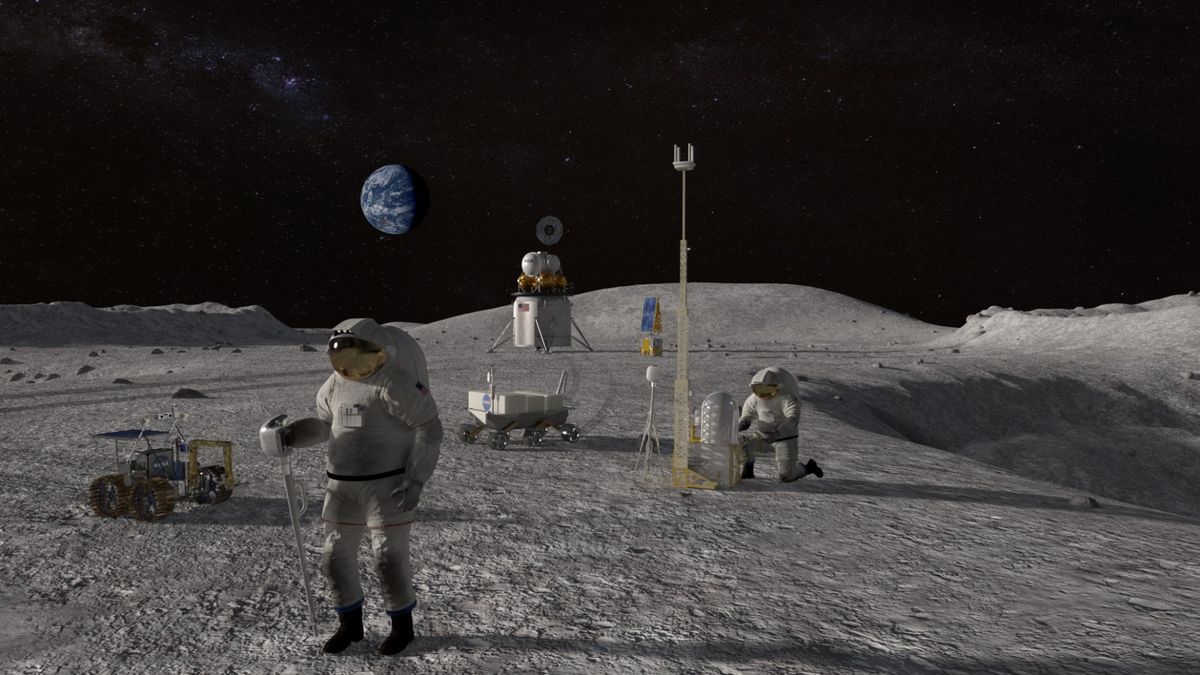
More than half a century after humanity's last steps on the Moon, a new race to our natural satellite is underway. Driven by renewed geopolitical, scientific, and economic ambitions, it brings together a considerable diversity of actors, from the superpowers of yesterday and today to new spacefaring nations, shaping the contours of an extended human presence beyond Earth.
Artemis: America's Orchestrated Return
Fifty years after the end of the Apollo program, the United States has officially resumed its journey to the Moon with the Artemis program. Led by NASA, this monumental project aims to establish a sustainable human presence on and around our satellite. After the successful uncrewed test flight of Artemis I in 2022, which validated the performance of the new Space Launch System (SLS) heavy-lift rocket and the Orion capsule, all eyes are now on the next steps. The Artemis II mission, planned for April 2026, will carry a crew of four astronauts, including one Canadian, for a ten-day flyby around the Moon. The main objective will be to test Orion's life support systems and deep-space navigation maneuvers under real conditions, a dress rehearsal before the great return to the lunar surface. The SLS, the most powerful rocket ever built, and the Orion capsule, designed for deep-space travel, form the backbone of this new ambition.
This return is scheduled for 2027 with the Artemis III mission. For the first time since Apollo 17 in 1972, astronauts, including the first woman, will walk on the Moon. The chosen destination is highly strategic: the South Pole. This region, with some of its craters in constant shadow, is suspected of harboring water ice, a resource that could potentially be exploited to produce drinking water, oxygen, and rocket propellant. The ambition of Artemis goes beyond simply repeating the feats of Apollo. It involves building a permanent infrastructure, including the cislunar Gateway space station, which will serve as a relay point for surface missions and, eventually, as a springboard for the exploration of Mars. NASA has also selected SpaceX and its Starship to develop the Human Landing System (HLS) that will land the astronauts on the surface. This colossal effort comes at a cost: the program is estimated at $93 billion through 2025, with each launch of the SLS and Orion alone representing an expenditure of $4.1 billion.
Chang'e: China's Methodical Progress
Facing the American offensive, China has established itself as a leading competitor. Its lunar exploration program, named Chang'e after the goddess of the Moon in Chinese mythology, is progressing with remarkable regularity and ambition. Far from merely following in American footsteps, China has achieved multiple world firsts. In January 2019, the Chang'e 4 mission accomplished the first-ever soft landing on the far side of the Moon. More recently, in May 2024, Chang'e 6 succeeded in the feat of collecting and returning to Earth the very first samples from this mysterious side, a major technical and scientific achievement that opens new perspectives on the formation and evolution of our satellite.
China's program does not intend to stop there. The Chang'e 7 mission, planned for 2026, will also target the lunar South Pole to search for water ice, placing it in direct competition with the objectives of Artemis III. By 2028, Chang'e 8 will be tasked with testing the technologies necessary for in-situ resource utilization and the construction of a lunar base. This base project, named the International Lunar Research Station (ILRS), is being developed in partnership with Russia and is intended as an alternative to the US-led architecture. Countries such as Venezuela, Pakistan, and South Africa have joined this initiative, which initially plans for a robotic base, to be inhabited from 2036. Step by step, China is building an autonomous access and operation capability on the Moon, laying the foundation for a long-term presence and affirming its status as a major space power.
The New Emerging Lunar Powers
This new lunar conquest is no longer the exclusive domain of the two superpowers. A new category of actors has made a noteworthy entrance onto the scene. India made a major impact on August 23, 2023, by becoming the fourth nation to achieve a soft landing on the Moon, and the very first to do so in the South Pole region with its Chandrayaan-3 mission. The small Pragyan rover was able to analyze the soil composition, confirming the presence of sulfur and other elements using its Alpha Particle X-ray Spectrometer (APXS) and Laser-Induced Breakdown Spectroscope (LIBS). This success, achieved with a remarkably modest budget of about $75 million, demonstrated the maturity of the Indian space program and paved the way for more ambitious missions, such as Chandrayaan-4, which is expected to attempt a lunar sample return by 2028.
A few months later, in January 2024, Japan became the fifth country to land on the Moon. Its SLIM (Smart Lander for Investigating Moon) mission achieved a landing of unprecedented accuracy, touching down less than 100 meters from its target. This high-precision landing capability, described as a "pinpoint landing," is a highly valuable technological skill for future exploration missions that will need to target specific sites of scientific interest or resource richness. JAXA, the Japanese space agency, is not working alone and is collaborating closely with India on the LUPEX (Lunar Polar Exploration Mission) project, which plans to send a rover to the South Pole to study water ice. These Indian and Japanese successes illustrate a fundamental trend: space exploration is becoming more accessible, and the Moon is now within reach of new nations with advanced technological capabilities.
Partners and Competitors with Mixed Fortunes
In this complex landscape, historical space powers are redefining their roles. Europe, through the European Space Agency (ESA), has chosen a collaborative approach by becoming a major partner in the Artemis program. ESA provides essential components, notably the European Service Module (ESM) for the Orion capsule, which handles propulsion, power supply, and life support. The agency is also making significant contributions to the future Gateway station with the I-HAB international habitation module and the ESPRIT telecommunications and refueling module. In parallel, Europe is developing its own exploration capabilities with the Argonaut heavy lander. Designed to carry up to 1.5 tons of cargo, scientific equipment, or infrastructure to the Moon's surface, Argonaut is scheduled for its first mission in 2030, offering Europe an autonomous capability for surface access and reducing its dependence on international partners.
Russia, the heir to the prestigious Soviet space program, has had a more difficult trajectory. Its attempt to return to the Moon ended in a bitter failure in August 2023, when the Luna 25 probe crashed during its landing maneuver. This incident, attributed to an engine problem, highlighted the difficulties of the post-Soviet Russian space program but did not end its ambitions. Moscow has reaffirmed its commitment to continuing its lunar missions (Luna 26, 27, and 28 are still planned) and has strengthened its cooperation with China on the ILRS lunar base project. This Sino-Russian partnership forms the main axis of opposition to the Western bloc led by the United States, sketching a lunar geopolitics that reflects terrestrial tensions and the formation of two distinct blocs in the race to establish a presence on the Moon.
The South Pole, the New Scientific and Strategic Eldorado
The convergence of most lunar programs towards the South Pole is no coincidence. This largely unexplored region holds promises that could transform the future of space exploration. Data collected by orbiters like NASA's Lunar Reconnaissance Orbiter have provided strong evidence for the presence of water ice in craters that never see sunlight. In these "cold traps," where temperatures can drop below -200°C, the ice could have been stable for billions of years.
Confirming the presence and exploitability of this water ice would be a considerable breakthrough. The water could be used for astronaut consumption, but more importantly, through electrolysis, it could be broken down into hydrogen and oxygen. These two elements are the basic components of rocket propellants. The ability to produce fuel directly on the Moon, a concept known as in-situ resource utilization (ISRU), would significantly reduce the mass to be launched from Earth and lower the costs of exploring the solar system. The Moon would then become a veritable gas station on the road to Mars and beyond. Beyond this utilitarian aspect, lunar ice is also a priceless scientific archive, potentially containing information about the formation of the solar system and the origin of water on Earth. The race to the South Pole is therefore both a quest for strategic resources and a search for answers to fundamental scientific questions.
The Emergence of the Private Sector
A fundamental difference from the 20th-century space race is the central role played by private companies. NASA, as part of the Artemis program, has adopted a new philosophy, acting more as a customer than a sole developer. The multi-billion dollar contract for the Human Landing System (HLS) was awarded to SpaceX for its Starship, and a second contract was given to Blue Origin for its Blue Moon lander. This competition aims to stimulate innovation and reduce costs. Similarly, the Commercial Lunar Payload Services (CLPS) program allows NASA to purchase payload capacity on private landers to send its scientific instruments. Companies like Astrobotic and Intuitive Machines have already sent missions to the Moon under this framework, with mixed success, illustrating both the potential and the risks of this new approach.
This new cislunar economy is not limited to major NASA contractors. A myriad of startups and established companies are positioning themselves across the entire value chain: rover construction, communication systems, energy production, resource extraction, and more. These private actors are not mere subcontractors; they are developing their own commercial ambitions, whether it be lunar tourism, mining, or space logistics. This new dynamic, where public and private interests intertwine, is accelerating the pace of exploration while raising new questions about the governance and sharing of lunar resources, currently governed by the 1967 Outer Space Treaty, which remains vague on commercial exploitation.
This new era of lunar exploration, characterized by a multiplicity of actors and objectives, is therefore much more than a simple repeat of the 1960s race. It is a reflection of the new technological, economic, and geopolitical realities of the 21st century. The coming years will see a wide variety of missions on and around our satellite, blending competition for resources and scientific firsts with cooperation on common infrastructure projects. Humanity's return to the Moon is no longer a question of "if," but of "how," and the answers that emerge will shape the future of our species in space.
Sources
- [1] The Conversation. The Moon race of the 2020s, theconversation.com
- [2] NASA. Artemis II, nasa.gov
- [3] NASA. Artemis III, nasa.gov
- [4] Wikipedia. Chinese Lunar Exploration Program
- [5] ISRO. Chandrayaan-3 Details, isro.gov.in
- [6] ESA. Argonaut: Europe's lunar lander programme, esa.int
- [7] JAXA. Smart Lander for Investigating Moon (SLIM), jaxa.jp
- [8] Wikipedia. Luna 25
- [9] NASA. FY 2025 Budget Request, nasa.gov