The Social Mobility of Migrants in Europe: An Elevator Over Two Generations
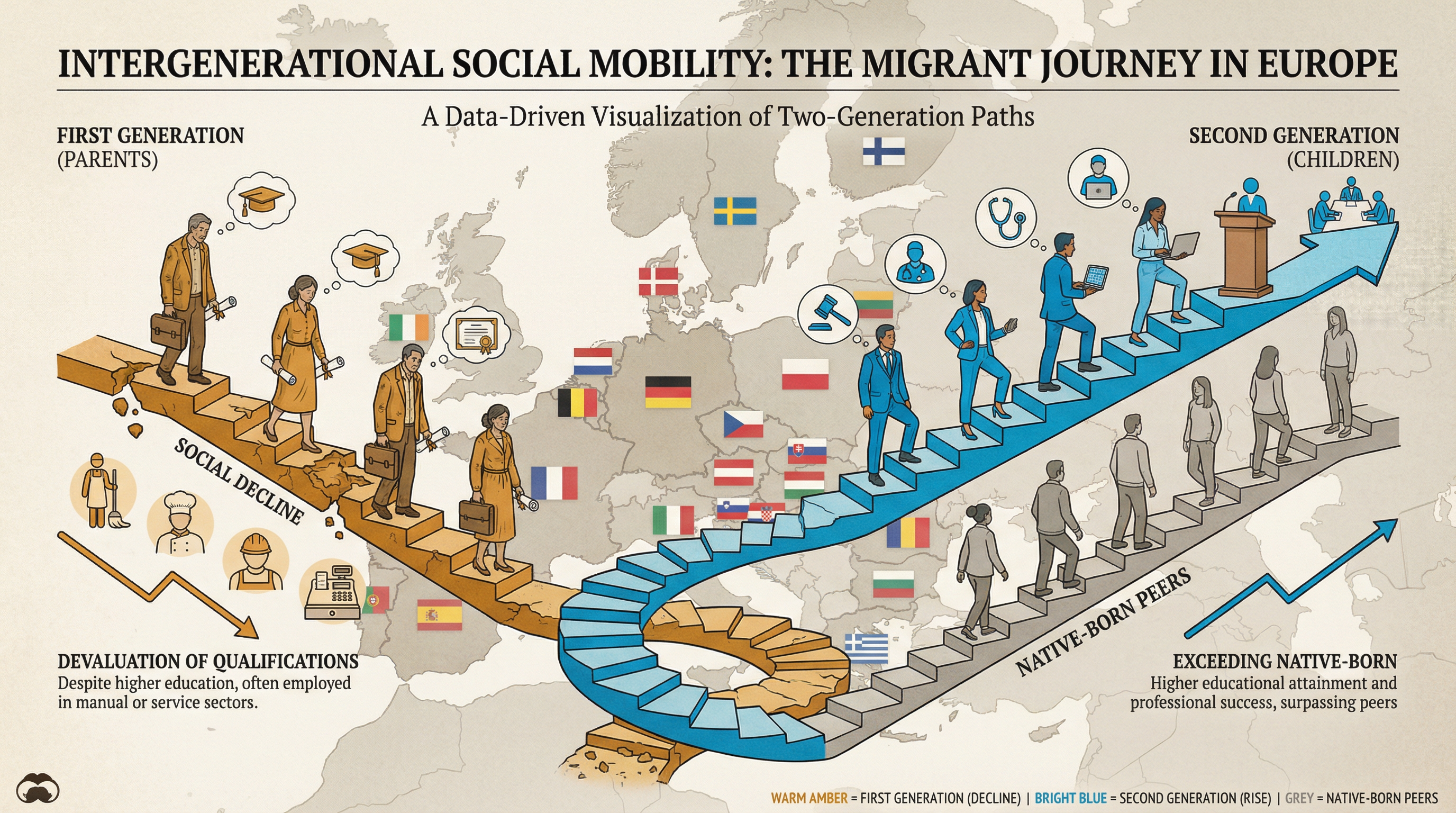
In Europe, the social trajectory of migrants unfolds over two generations. A study by the Institute for New Economic Thinking at the University of Oxford (INET Oxford), covering 22 European countries, reveals a complex pattern, far from simplistic narratives. First-generation migrants often experience downward social mobility, holding jobs below their qualifications. Their children, on the other hand, not only manage to bridge this gap but, in some cases, exhibit upward mobility superior to that of natives. This phenomenon suggests that integration is an intergenerational process, the fruits of which are reaped by the next generation.
The Downgrading of the First Generation: An Entry Cost into the European Labor Market
The INET Oxford study highlights a central paradox: while first-generation migrants often improve their economic conditions compared to their country of origin, they experience significant downward social mobility professionally. This phenomenon, termed downgrading, translates into holding jobs that do not match their qualification level. Doctors, engineers, or professors thus find themselves working as laborers, drivers, or maintenance workers.
The EU-SILC 2019 survey data, on which the study relies, confirms this trend in 22 European countries. Downward mobility in terms of social class is more frequent for first-generation migrants than upward mobility. This cost of migration is particularly visible in countries where foreign diploma recognition systems are inefficient. In France, for example, descendants of immigrants are more often from modest backgrounds: 52% have a father who was a laborer, compared to 35% for the population without direct migratory ancestry.
However, this professional downgrading coexists with upward mobility in terms of economic conditions. On average, first-generation migrants have a higher chance of improving their economic situation than natives. They manage to escape poverty and offer their children better living conditions than they themselves experienced. This duality of mobility—downward in status, upward economically—is an essential key to understanding migratory trajectories.
The Second Generation: A Spectacular Catch-Up
If the first generation pays the price of migration, the second seems to reap the rewards. The INET Oxford study and INSEE data converge to show a catch-up, even an over-performance, among descendants of immigrants. In France, intergenerational social mobility is stronger for descendants of immigrants than for the rest of the population. Only 19% of descendants of immigrants aged 30 to 59 belong to the same socio-professional category as their father, compared to 26% for individuals with no link to migration.
This greater social fluidity translates into remarkable upward mobility. Among descendants of immigrants whose father was an unskilled laborer, 33% attain positions as managers or intermediate professionals. This proportion is only 27% for individuals without direct migratory ancestry from the same social background. The social elevator thus seems to function more effectively for the children of immigrants, who capitalize on their parents' sacrifices and the opportunities offered by the host society, particularly the educational system.
Sweden, France, Germany: Three Integration Models, Three Different Outcomes
The current situation of migrant social mobility in Europe is the legacy of over half a century of migratory waves and contrasting public policies. After World War II, reconstruction and the strong economic growth of the "Trente Glorieuses" (Thirty Glorious Years) generated a massive need for labor, filled by the arrival of immigrant workers. France, Germany, the United Kingdom, and Belgium thus saw populations from Southern Europe, the Maghreb, Turkey, or their former colonies settle permanently.
However, integration models have varied significantly from one country to another. France has long promoted an assimilationist model. The United Kingdom opted for a multiculturalist model. Germany long considered its guest workers (Gastarbeiter) as a transient population, only implementing active integration policies late.
The INET Oxford study highlights that countries with effective foreign diploma recognition systems, such as Sweden or the Netherlands, manage to limit the professional downgrading of the first generation. Similarly, countries that invest heavily in the education of migrant children, such as Finland or Denmark, foster upward mobility for the second generation. The quality of the educational system and targeted integration policies thus appear to be determining factors in transforming the potential of new generations into social success.
Data Predates COVID and Does Not Distinguish Geographical Origins
The general trends are clear, but the reality of migrant social mobility is marked by many nuances.
Firstly, the data used, such as the EU-SILC 2019 survey, predates major events like the COVID-19 pandemic and new migratory waves linked to the war in Ukraine. These crises may have reconfigured the labor market and mobility opportunities for immigrant populations.
Secondly, the category of migrant or descendant of a migrant masks a great heterogeneity of situations. Geographical origin, level of education upon arrival, legal status, gender, or skin color are all factors that create very diverse mobility trajectories.
Thirdly, mobility gaps are not solely explained by objective factors like diploma level. Factors such as discrimination in hiring, weak professional social networks, or language barriers continue to hinder social advancement, even for the second generation.
33% of Children of Immigrant Laborers Become Managers, Compared to 27% Among Natives
The conclusions of the INET Oxford study and national data like that from INSEE have major political implications. They invite a rethinking of integration policies with a long-term perspective, focused on the second generation. While the professional integration of newcomers remains a challenge, investment in education, training, and equal opportunities for their children appears to be the most powerful lever for ensuring successful integration and lasting social cohesion.
This data offers a nuanced and ultimately optimistic perspective on immigration. It shows that, despite difficulties and discrimination, integration is a process that works, over two generations. The success of the second generation is an indicator of a society's ability to transform diversity into strength. It testifies to the resilience of migrant families and the effectiveness of public institutions, foremost among them the republican school system.
However, this success is not a given. It is conditional on maintaining strong public investment in education, combating discrimination, and promoting equal opportunities. Faced with the rise of populist discourse that instrumentalizes the migration issue, this factual data is a necessary reminder: immigration, when accompanied by ambitious public policies, is an opportunity for Europe's social and economic progress.
Sources
- Bavaro, M. & Trinh, N.A. (2026). The intergenerational social mobility of migrants in 22 European countries. INET Oxford Working Paper No. 2026-02.
- INSEE (2023). Origine sociale et mobilité intergénérationnelle des descendants d'immigrés et de natifs d'Outre-mer.
- OECD (2023). International Migration Outlook 2023. OECD Publishing.