Liana Cutting in Borneo: A Forest Restoration Method Four Times Faster and Ten Times Cheaper Than Tree Planting
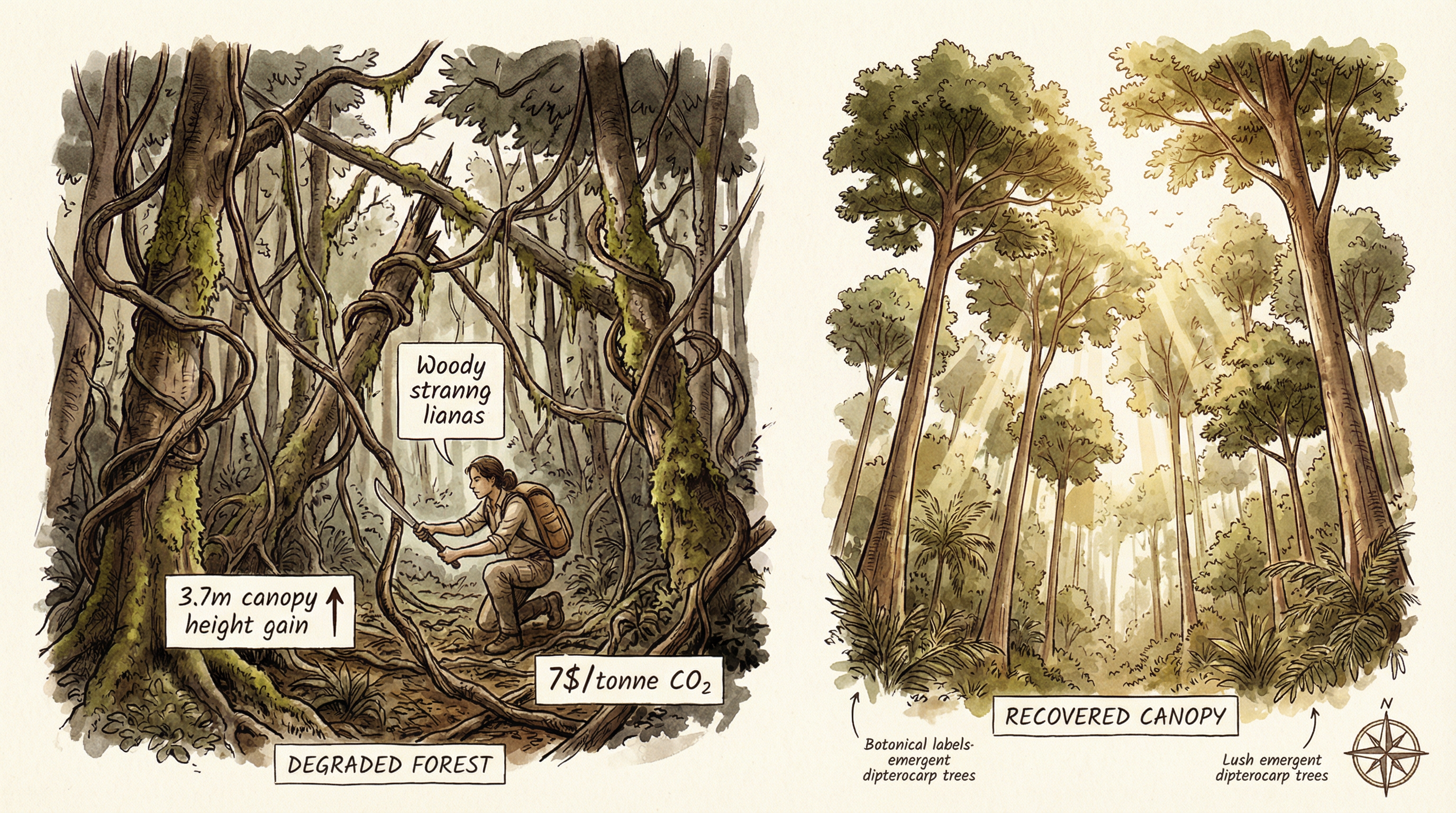
In a tropical forest in Borneo, degraded by logging, a targeted intervention accelerated canopy growth by 3.7 meters in just nine years. This method, the simple cutting of lianas, proved to be not only more than four times faster than tree planting, which produced a gain of only 1.6 meters in eighteen years, but also ten times less costly. These results, stemming from a large-scale study conducted over nearly two decades, suggest a new, pragmatic, and highly efficient path for restoring the planet's green lungs.
A Demonstration by the Numbers: The Sabah Experience
The study highlighting this approach was conducted within the Sabah Biodiversity Experiment (SBE), one of the largest and oldest experimental forest restoration projects in the world, located in the Malaysian part of Borneo island. Over an area of 500 hectares of dipterocarp forest, selectively logged in the 1980s, researchers compared the long-term effectiveness of several restoration methods. By using airborne laser scanning (ALS) data collected between 2013 and 2020, they were able to reconstruct the forest's 3D structure and precisely measure its growth dynamics.
The results are unequivocal. Liana cutting produced a net canopy height gain of 3.7 meters over nine years, compared to 1.6 meters for enrichment planting over eighteen years. In terms of additional carbon sequestration, the difference is equally spectacular: +1.31 Mg C ha⁻¹ an⁻¹ for liana cutting versus +0.38 Mg C ha⁻¹ an⁻¹ for planting. Tree mortality, another key indicator, was halved in the treated plots: approximately 5 trees per hectare over seven years, compared to 10 for planting and untreated forest.
The mechanism behind this success is twofold. Firstly, the release from competition for light, water, and nutrients allowed existing trees to grow faster. The height growth rate in canopy gaps was 1.1 meters per year in treated plots, compared to 0.86 m/year for planting and 0.71 m/year for the forest left to itself. Secondly, liana cutting halved tree mortality—lianas, by physically overloading trees and creating bridges for falling neighboring trees, significantly contribute to their mortality. By removing this pressure, the intervention allowed for the preservation of trees that would otherwise have died, accounting for 54 % of the total observed biomass gain.
In terms of cost, researchers estimate that liana cutting allows for carbon sequestration at approximately 7 dollars per tonne—one of the most cost-effective nature-based climate solutions ever documented.
More Than Half of Remaining Tropical Forests Are Degraded by Selective Logging
To understand the scope of this discovery, it is necessary to contextualize tropical deforestation and forest degradation. More than half of the world's remaining tropical forests are now considered degraded, primarily due to selective logging. This practice, particularly intense in Southeast Asia in the 1970s and 1980s, involves harvesting only trees of high commercial value. In Borneo, this mainly concerns dipterocarps, giants that structure the ecosystem and store massive amounts of carbon.
The felling of these trees creates gaps in the canopy, damages soils, and disrupts the forest's fragile balance. Crucially, it eliminates the main seed producers, compromising natural regeneration—dipterocarp seeds have a very short lifespan and do not form a seed bank in the soil. Under these conditions of increased light and disturbance, lianas proliferate. Naturally present in forests, they become aggressive competitors in degraded environments. Studies conducted in Central America and the Amazon have shown that an increase in atmospheric CO2 concentration could even favor lianas, which are more efficient at utilizing this resource than many trees.
Faced with this challenge, the most publicized and funded restoration method has long been massive tree planting. Initiatives like the Bonn Challenge, which aims to restore 350 million hectares of degraded land by 2030, have largely relied on this approach. However, planting is costly (between 1,500 and 2,500 dollars per hectare in Borneo), its success is highly variable, and it is often unsuitable for merely degraded forests, where assisted natural regeneration might be more relevant.
The Method Only Works in Degraded Forests, Not on Cleared Land
The results of the Borneo study must be interpreted with caution. Liana cutting is not a miracle solution applicable to all deforestation situations.
Firstly, the study's context is very specific. It was conducted in a selectively logged forest, meaning an ecosystem that, although degraded, retains a basic forest structure. In contrast, on lands entirely cleared and converted to agriculture then abandoned, there is no longer any regeneration potential to be unleashed. In these cases, tree planting remains an indispensable step.
Secondly, the long-term effects of systematic liana cutting are still poorly understood. The study provides valuable insight over a decade, but forest dynamics are measured over centuries. By rapidly densifying the canopy, liana cutting could, in the long run, intensify competition among the trees themselves. Continuous monitoring is essential.
Thirdly, lianas are not mere parasites. They are an integral component of tropical forest ecosystems and play an important ecological role: a food source and travel routes for many animal species (primates, sloths, birds), and a contribution to nutrient cycles. Their systematic elimination over large areas could have unforeseen consequences for biodiversity.
Finally, the study by Jackson et al. is, at the time of this publication, a preprint. Its results, although based on robust field data, have not yet undergone the full peer-review process.
7 Dollars Per Tonne of CO₂: A Cost That Could Transform the Restoration Model
The demonstration of the effectiveness of liana cutting represents a potential paradigm shift in how tropical forest restoration is conceived. Rather than focusing on heavy and costly interventions aimed at rebuilding a forest from scratch, this approach embodies a philosophy of assisted natural regeneration: identifying and removing the barriers that block an ecosystem's natural resilience processes to allow it to repair itself.
For millions of hectares of degraded but not destroyed forests, this approach offers a pragmatic and economically viable path. For tropical countries with limited resources but facing ambitious restoration goals—Indonesia, Brazil, Democratic Republic of Congo—liana cutting can become a leading tool. It is not only cheaper but also simpler to implement, requiring no nurseries, complex seedling transport logistics, or specialized horticultural expertise. It can be deployed on a large scale by local communities, creating green jobs and strengthening sustainable management of forest territories.
This method could also transform the economic model of logging. By integrating liana cutting as a standard silvicultural practice after felling, forestry companies could significantly accelerate the regeneration of their concessions and access climate financing such as that from the REDD+ mechanism. The challenge now is to translate this scientific knowledge into political and on-the-ground action.
Sources
- Jackson, T.D. et al. (2026). Liana cutting accelerates tropical forest recovery at a fraction of the cost of tree planting. bioRxiv (preprint).
- Cerullo, G.R. & Edwards, D.P. (2019). Actively restoring resilience in selectively logged tropical forests. Journal of Applied Ecology, 56(1), 107-118.
- Bonn Challenge. About the Bonn Challenge.