40% of the World's 7,000 Languages Are Threatened: Oceania and Central America on the Front Line
# 40% of the World's 7,000 Languages Are Threatened: Oceania and Central America on the Front Line
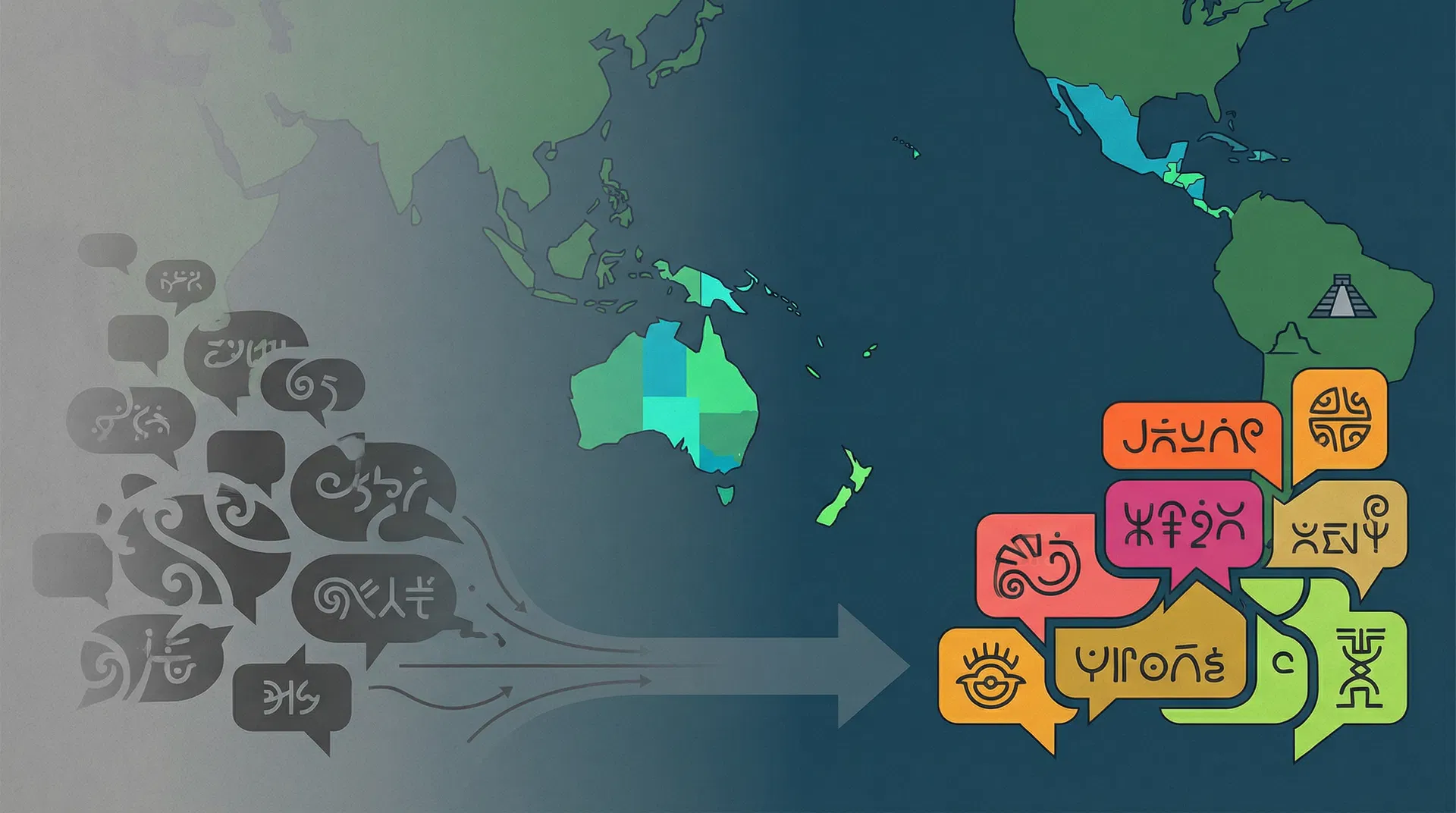
Nearly 40% of the 7,000 languages spoken worldwide are threatened with extinction, a phenomenon that is accelerating with one language dying out every two weeks on average. This linguistic erosion, particularly pronounced in Oceania and Central America, leads to an irreversible loss of unique ecological, medical, and cultural knowledge. Faced with this observation, revitalization initiatives, such as those seen in New Zealand with Māori, demonstrate that it is possible to reverse this trend through targeted actions and strong political will. [1] [2]
3,193 Languages Threatened Out of 7,159 Recorded Worldwide
Of the 7,159 living languages recorded across the globe, 3,193, or 44%, are currently considered threatened. This figure includes 337 "dormant" languages and 454 "extinct" languages, according to Ethnologue data. A language is considered "dormant" when it no longer has competent speakers but retains social and identity value for an ethnic community. "Extinct" languages, on the other hand, no longer have speakers and are not claimed by any group. The disappearance of a language is a gradual process that begins when speakers stop transmitting it to younger generations in favor of a more dominant language, often perceived as offering better economic or social opportunities. [1]
Oceania and the Americas, Epicenters of the Linguistic Crisis with 80% of Endangered Languages Concentrated in 25 Countries
Just 25 countries are home to approximately 80% of the world's endangered languages. Oceania, with its multitude of islands and distinct cultures, is home to the largest number of endangered languages, followed by Asia, Africa, and the Americas. In North and Central America, almost all indigenous languages are threatened, a direct legacy of colonization and assimilation policies. For example, Louisiana Creole, a French-based Creole with African and indigenous influences, is severely threatened in the United States, mainly spoken by elders. Its survival depends on intergenerational transmission and integration into educational systems. In Bolivia, Leco, an isolated indigenous language with no known genetic link to other languages, is also only spoken by the elderly, despite an ethnic Leco population of approximately 13,500 individuals. These examples illustrate the fragility of languages in the face of external and internal pressures. [1]
A Language Disappears Every Two Weeks, Taking Irreplaceable Knowledge and a Unique Worldview with It
The current rate of language disappearance is alarming: one language dies out on average every two weeks. Each linguistic disappearance represents the loss of a unique system of thought, including valuable knowledge about biodiversity, traditional medicinal practices, and cultural narratives. This knowledge, often transmitted orally, is intrinsically linked to the language and disappears with it, impoverishing the collective human heritage. For example, many indigenous languages contain extremely precise vocabularies to describe the flora, fauna, and natural phenomena of their environment, knowledge that can be vital for understanding and preserving ecosystems. The loss of a language is also the loss of a unique way of perceiving and interacting with the world, an irreplaceable vision that enriches human diversity. [2]
Colonization, Urbanization, and Educational Policies: Historical and Contemporary Factors of Linguistic Decline
Colonization historically imposed dominant languages, marginalizing indigenous languages and often prohibiting them in schools and public spaces. This repression had devastating effects on intergenerational transmission. Today, rapid urbanization and unilingual educational policies continue to exert considerable pressure. Migration to cities, where dominant languages are often the norm, and limited access to education in the mother tongue contribute to the decrease in the number of speakers, particularly among younger generations. Mass media and the internet, while potentially tools for revitalization, can also accentuate the dominance of majority languages if specific efforts are not made to promote linguistic diversity online. [2]
Revitalization Successes Prove the Effectiveness of Proactive Policies and Community Engagement
Despite the bleak picture, examples of successful language revitalization offer optimistic perspectives and models to follow. In New Zealand, Māori has experienced a spectacular revival thanks to intensive community programs, language immersion schools (Kōhanga Reo), and modern learning applications. The number of Māori speakers has increased, and the language is now a vibrant element of national identity. In Wales, Welsh, once in decline, is now taught in schools, used in public administration, and supported by Welsh-language media. The 2021 census showed an increase in the number of speakers. Hawaii has also implemented initiatives to revive its indigenous language, ʻŌlelo Hawaiʻi, through immersion schools and university programs. Cornish (Kernewek), spoken in southwest England, was removed from UNESCO's list of extinct languages in 2010 after revitalization efforts, and is now spoken as a first language by 563 people according to the 2021 census. These cases demonstrate that concerted efforts, involving governments, communities, and educators, can reverse the trend of disappearance and restore linguistic vitality. [1]
Multilingual Education, a Key Lever for Linguistic Preservation and Social Justice
Multilingual education is an essential pillar for the preservation of non-dominant, minority, and indigenous languages. It promotes social inclusion and guarantees individuals' rights to express themselves and learn in their mother tongue. Studies show that using the mother tongue in education not only improves learning outcomes but also self-esteem and the development of critical thinking in children. Currently, 40% of the world's population does not have access to education in their mother tongue, a figure that exceeds 90% in some regions, creating deep inequalities. Promoting multilingual education is therefore a major issue for linguistic diversity, social justice, and the recognition of cultural identities. This involves developing adapted school curricula, training bilingual teachers, and creating educational resources in these languages. [2]
[1] : Al Jazeera. (2026, February 21). Where are the most endangered languages in the world? https://www.aljazeera.com/news/2026/2/21/where-are-the-most-endangered-languages-in-the-world
[2] : UNESCO. (2024, March 5). Multilingual education, the bet to preserve indigenous languages and justice. https://www.unesco.org/en/articles/multilingual-education-bet-preserve-indigenous-languages-and-justice