AI Slows Youth Hiring Without Increasing Overall Unemployment
# AI Slows Youth Hiring Without Increasing Overall Unemployment
Generative artificial intelligence, since its rapid proliferation in late 2022, has reignited questions about its impact on the labor market. While a wave of job destruction was feared, initial data suggests a more complex dynamic. Far from a generalized increase in unemployment, AI appears instead to alter entry points into certain professions, specifically affecting young workers.
A study by Anthropic, published in March 2026, highlights this phenomenon: the global labor market is not experiencing a systematic rise in unemployment in AI-exposed positions. However, for those aged 22-25, the picture is different, with a notable slowdown in new hires in these same professions. This divergence raises questions about the professional integration of new generations and the adaptation of skills to a changing technological environment.
Overall Unemployment Stable Despite AI Acceleration
Since late 2022 and the widespread diffusion of generative artificial intelligence tools, many observers have anticipated a major disruption to the labor market. Yet, the Anthropic study, titled "Labor market impacts of AI: A new measure and early evidence," finds no systematic increase in the unemployment rate for workers in highly AI-exposed positions [1]. This finding suggests that the integration of AI has not yet led to massive job destruction resulting in a rise in unemployment at the global level. Companies appear instead to be adapting their working methods and tasks within existing roles, rather than engaging in widespread layoffs.
This result aligns with a historical perspective where technological advancements, while transforming production methods, have rarely led to persistent long-term mass unemployment. Nevertheless, the absence of a visible increase in overall unemployment does not signify an absence of impacts, but rather that these impacts are manifesting in more subtle and differentiated ways, particularly on labor market entry flows [2].
Hiring of Young People Aged 22 to 25 Slows by 14% in Exposed Professions
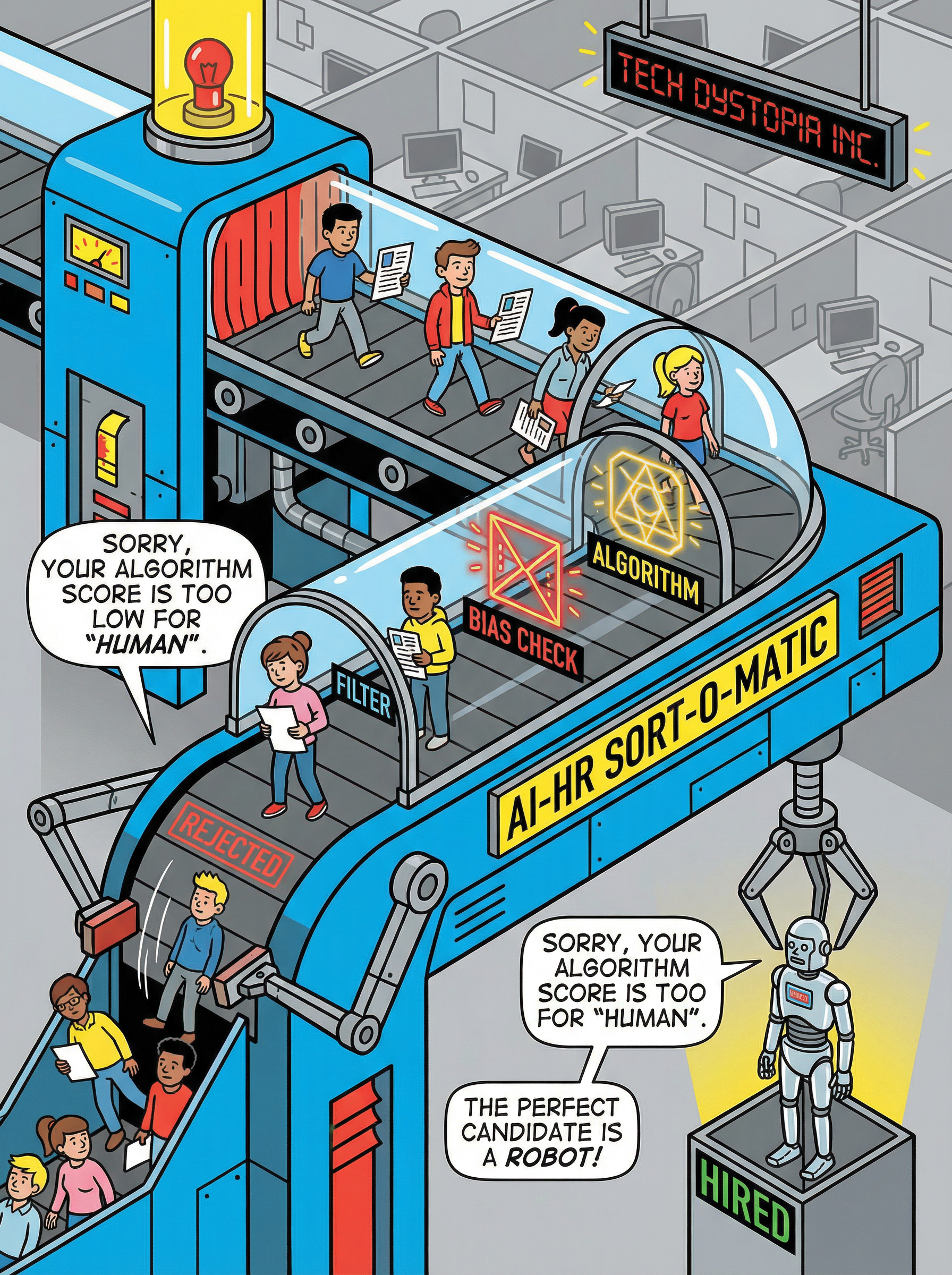
Despite overall unemployment stability, the Anthropic study reveals a distinct trend for young workers. Employment entry rates for those aged 22-25 in the most AI-exposed professions have decreased by approximately 14% since 2022 [1]. This age group, often seeking its first significant professional experience, appears to face greater difficulties in entering these sectors. Another study, cited by Anthropic and conducted by Brynjolfsson et al. (2025), confirms this 6-16% decline in employment among 22-25 year olds in exposed professions, attributing this decrease primarily to a slowdown in hiring rather than an increase in exits [1].
Maxim Massenkoff and Peter McCrory, from Anthropic, highlight this divergence: « We find no systematic increase in unemployment for highly exposed workers since late 2022, though we find suggestive evidence that hiring of younger workers has slowed in exposed occupations » [1]. This slowdown in hiring suggests that employers may be prioritizing more experienced profiles capable of adapting to AI tools, or that certain junior roles are now partially automated or require different skills upon entering the labor market [3].
Measuring AI Exposure: Beyond Theory
To assess the impact of AI, Anthropic's study developed a new measure: "observed exposure." This approach goes beyond the theoretical capability of a large language model (LLM) to accelerate a task. It quantifies tasks that are not only achievable by AI, but also genuinely utilized in an automated manner in professional contexts [1]. To do this, Anthropic analyzed approximately 800 occupations in the United States, combining data from the O*NET database (describing occupational tasks), internal usage of its own tools (Anthropic Economic Index), and task-level exposure estimates from Eloundou et al. (2023) [1].
An occupation is considered more exposed if a significant portion of its tasks can be accelerated by AI, if these tasks are frequently automated via APIs or specific usage patterns, and if they represent a significant part of the overall role [1]. Among the occupations identified as most exposed are computer programmers (with 75% coverage), as well as customer service representatives and data entry operators (67% coverage) [1]. Furthermore, the study notes a correlation between AI exposure and the Bureau of Labor Statistics (BLS) employment growth projections for 2024-2034: for every 10 percentage point increase in observed exposure, the BLS growth projection decreases by 0.6 percentage points, indicating slower growth for more exposed jobs [1].
Specific Worker Profiles and Nuanced Interpretations
The study also reveals specific characteristics of workers in the most AI-exposed professions. These individuals are more likely to be older, female, more educated, and better paid [1]. For instance, 17.4% of individuals in the most exposed group hold a postgraduate degree, compared to 4.5% in the non-exposed group [1]. This suggests that AI might initially affect positions requiring a certain level of qualification, but where a portion of tasks is now automatable, rather than exclusively low-skilled jobs.
It is necessary to nuance these observations. The slowdown in youth hiring could have several explanations [1]. Young people not hired into these professions might choose to remain in their current jobs, transition to other sectors less exposed to AI, or return to education to acquire new skills [4]. Job transitions and professional integration behaviors can be complex to measure accurately in surveys [1]. The impact of AI could manifest as a reduction in junior positions, a slowdown in promotions, or wage compression, without necessarily causing mass layoffs [2, 5]. The study itself acknowledges that « this framework is most useful when effects are ambiguous – and could help identify the most vulnerable jobs before displacement is visible » [1].
These initial findings emphasize that the integration of AI into the world of work is not a uniform wave of destruction, but rather a targeted transformation. The question remains how educational systems and employment policies can support this transition to ensure equitable integration for younger generations.