Freedom House 2026: 20 Years of Declining Freedoms — and the Counter-Trends That Resist
# Freedom House 2026: 20 Years of Declining Freedoms — and the Counter-Trends Resisting Them
Pillar : Society, Democracy & Culture | Format : Curated commentary | Date : March 20, 2026
---
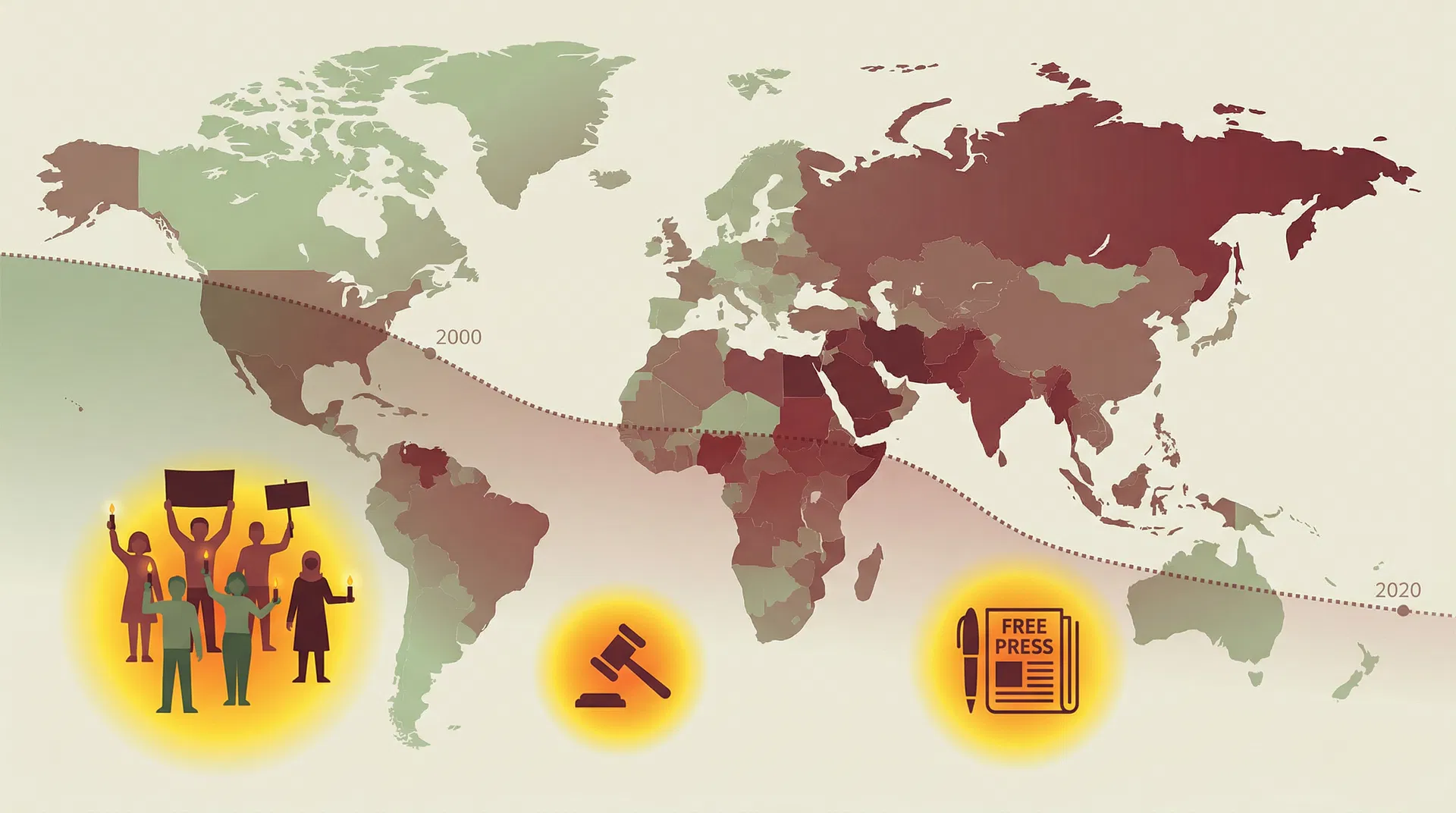
On March 19, 2026, Freedom House published its annual report, Freedom in the World 2026, titled "The Growing Shadow of Autocracy." The main conclusion: political and civil liberty has declined for the 20th consecutive year worldwide. In 2025, 54 countries experienced a deterioration of their political rights and civil liberties, compared to 35 that registered progress. Only 21% of the world's population now lives in countries classified as "free" — down from 46% twenty years ago.
However, the report also documents something else, less frequently cited: 35 countries making progress, 18 nations undergoing an active democratization process, and concrete examples of civic and institutional resistance that have reversed authoritarian trends. The decline is real and documented — but it is not inevitable.
Editorial note: This report covers civil and political liberties (freedom of the press, political rights, freedom of association), and differs from the V-Dem report discussed in Cycle 11, which measures the liberal democracy index. The two approaches are complementary.
---
54 Countries in Decline, 21% of Global Population "Free": Twenty Years of Data Across 195 Countries
The report covers 195 countries and territories. It assigns each country a score out of 100 points (political rights + civil liberties). Countries are classified into three categories: "Free" (score 70-100), "Partially Free" (40-69), and "Not Free" (0-39).
Key Data:
- 54 countries in decline in 2025, 35 making progress
- 21% of the world's population in "free" countries (vs 46% in 2005)
- Since 2005: 19 countries have moved from "Partially Free" to "Not Free"; only 9 have progressed from "Partially Free" to "Free"
- The sharpest declines in 2025: Guinea-Bissau (-8), Tanzania (-7), Burkina Faso (-5)
Commentary: The underlying trend is clear and documented over two decades. What is new in the 2026 edition is the extent of deterioration within "free" countries themselves — and particularly in the United States. But the same edition also documents 35 countries making progress: this is a signal that the dynamic is not uniform.
Source: [Freedom House, March 19, 2026](https://freedomhouse.org/article/new-report-global-freedom-declined-20th-consecutive-year-2025)
---
United States Loses 10 Points Since 2016: The Steepest Decline Among Established Democracies
Among the 88 countries classified as "free," the United States registered the steepest decline in 2025: -3 points, for a score of 81/100. Bulgaria (-3) and Italy (-2) also declined, but to a lesser extent.
Key Data: Freedom House cites several factors for the American decline: attacks on judicial independence, pressures on press freedom, restrictions on ballot access in some states, and attempts to weaken institutional checks and balances.
Commentary: A 3-point decline for a country scoring 81/100 might seem marginal. It is not. The trajectory matters as much as the level: the United States has lost 10 points since 2016. But the report also notes that American institutions — federal courts, independent press, civil society — have resisted several attempts at weakening them. Institutional robustness is precisely what Freedom House seeks to measure: not just the current level, but the capacity of institutions to withstand pressures.
Source: [Freedom in the World 2026](https://freedomhouse.org/sites/default/files/2026-03/FIW2026_final_digital%20%281%29.pdf)
---
Poland, Brazil, and Senegal: Three Democratic Recoveries in One Year
This is the least publicized — and perhaps most instructive — part of the report. Freedom House identifies several documented cases of democratic recovery in 2025.
Poland is the most spectacular example in Europe. After eight years of the PiS (Law and Justice) government, which had systematically weakened judicial independence, appointed partisan judges to the Constitutional Court, and restricted public press freedom, the October 2023 elections brought about a change in government. In 2025, the Tusk government initiated a process of restoring judicial independence — encountering institutional resistance, but making measurable progress. Freedom House raised Poland's score by +2 points in 2025.
Brazil also advanced by +2 points. After the attempted coup d'état on January 8, 2023, Brazilian institutions — the Supreme Court, Congress, and the military — resisted and organized legal proceedings against those responsible. The V-Dem report cites Brazil as one of the most significant examples of "democratic resilience" in 2024-2025: a democracy that suffered a frontal attack and institutionally survived it.
Senegal experienced a peaceful change of government in 2024, following a period of intense political tensions. The presidential election in March 2024, initially postponed by President Sall, eventually took place and led to the election of Bassirou Diomaye Faye — a democratic alternation in a regional context (West Africa) marked by several coups d'état. Freedom House raised Senegal's score by +3 points.
Key Data: 18 nations worldwide are currently undergoing an active democratization process, according to V-Dem. This figure represents 10% of the total countries covered — a positive signal in an overall worrying picture.
Source: [Freedom House / V-Dem, March 2026](https://freedomhouse.org/article/new-report-global-freedom-declined-20th-consecutive-year-2025)
---
Georgia, Turkey, Russia: Civil Societies Enduring Under Authoritarian Pressure
Beyond institutional indicators, the Freedom House report and complementary analyses document the vitality of civic resistance in authoritarian contexts.
In Georgia, massive demonstrations against the "foreign agents" law (modeled on Russian legislation) mobilized hundreds of thousands of people in 2024-2025. The movement achieved partial concessions from the government and maintained constant pressure on institutions. Freedom House notes that Georgian civil society remains "remarkably active" despite the pressures.
In Turkey, the arrest of Istanbul mayor Ekrem İmamoğlu in March 2025 triggered demonstrations in 81 Turkish cities — the largest since the Gezi movement in 2013. The opposition maintained a street presence for several weeks, illustrating the persistence of democratic demand in a society under increasing authoritarian pressure.
In Russia, despite systematic repression since 2022, civic resistance networks continue to operate — both within the country (underground independent journalism, aid networks for conscientious objectors) and in exile (independent Russian-language media reaching millions of readers). Freedom House notes that Russian civil society in exile is "more active and better organized than at any other time since 1991."
Commentary: These examples illustrate a phenomenon documented by research on democratization: civic movements that maintain constant pressure on authoritarian institutions create the conditions for future transitions. Poland in 2023 would have been unthinkable without years of resistance from Polish civil society between 2015 and 2023. Brazil in 2023 would have been unthinkable without the mobilization of judicial and military institutions that refused to follow the putschists in January 2023.
Source: [National Endowment for Democracy, March 2026](https://www.ned.org/democracy-digest/2026/03/civic-resistance-2025-year-in-review/)
---
Summary
The Freedom House 2026 report confirms a trend documented for two decades: the decline of civil and political liberties is global, persistent, and now affects established democracies. The new development in 2025 is the deterioration in the United States. But the same report documents 35 countries making progress, democratic recoveries in Poland, Brazil, and Senegal, and active civic resistance in challenging contexts such as Georgia, Turkey, and Russia. The decline is not inevitable. It is the product of political decisions — and it can be reversed by other political decisions, supported by resilient civil societies.
---
Sources
1. Freedom House (2026, March 19). Freedom in the World 2026: The Growing Shadow of Autocracy. https://freedomhouse.org/report/freedom-world/2026/growing-shadow-autocracy
2. Freedom House (2026, March 19). Press release: "Global Freedom Declined for 20th Consecutive Year in 2025." https://freedomhouse.org/article/new-report-global-freedom-declined-20th-consecutive-year-2025
3. V-Dem Institute (2026, March 17). Press release: "Democratic Backsliding Reaches Western Democracies." https://www.v-dem.net/news/press-release-democratic-backsliding-reaches-western-democracies-with-us-decline-unprecedented/
4. National Endowment for Democracy (2026, March). "Civic Resistance 2025: Year in Review." https://www.ned.org/democracy-digest/2026/03/civic-resistance-2025-year-in-review/
5. CFR (2026, March 19). "Freedom House's Annual Report Shows the Dire State of Democracy Worldwide." https://www.cfr.org/articles/freedom-houses-annual-report-shows-the-dire-state-of-democracy-worldwide