Power and Progress: Our Thousand-Year Struggle Over Technology and Prosperity
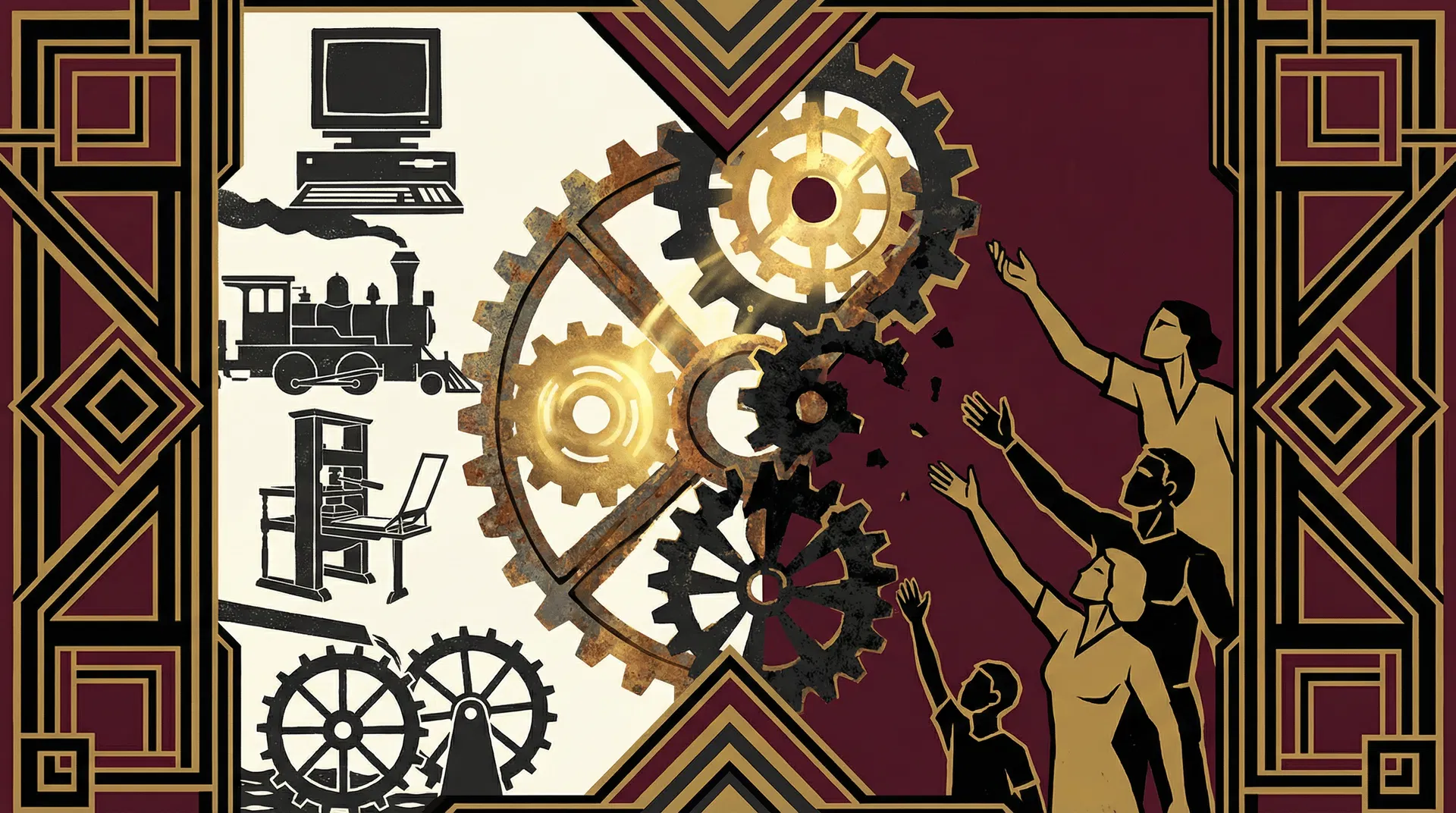
# Power and Progress: Our Thousand-Year Struggle Over Technology and Prosperity
*Daron Acemoglu and Simon Johnson, Pearson France, November 2024, 632 pages, €29.90. Translated from English by Christophe Jaquet. Original title: Power and Progress: Our Thousand-Year Struggle Over Technology and Prosperity (PublicAffairs, May 2023).*
The two winners of the 2024 Nobel Prize in Economics trace a thousand years of the relationship between technology and prosperity to demonstrate a simple and well-documented thesis: technical progress only improves the living conditions of the many when institutional and social counter-powers force the sharing of gains. Without these counter-powers, the benefits of innovation are concentrated in the hands of those who control the technology.
The Thesis: Technical Progress Does Not Trickle Down
Acemoglu and Johnson start from an empirical observation. In Europe, the standard of living of the peasantry remained stable from the 11th to the 17th century, despite the agricultural innovations of the Middle Ages (heavy plough, three-field system, water mill). Productivity gains were captured by feudal lords and the Church. The mechanism repeated itself during the first industrial revolution: between 1760 and 1840, British textile production increased twelvefold, but the real wages of workers stagnated for eighty years. In 1845, Friedrich Engels documented living conditions in Manchester that were inferior to those in pre-industrial rural areas [1].
The authors call this phenomenon the "narrative trap": as soon as a discourse automatically associating technology and prosperity becomes dominant, it neutralizes any questioning of the distribution of gains. This trap operates today through the discourse of large technology companies, which present automation as inevitable and universally beneficial.
A Thousand Years in Ten Chapters
The book covers five periods. Chapters 1 to 3 analyze the Middle Ages and the first industrial revolution. Chapters 4 and 5 examine the second industrial revolution (1870-1914), where electrification and chemistry for the first time created entire categories of new jobs (technicians, foremen, office workers) in addition to automating old ones.
Chapters 6 and 7 focus on the period 1945-1975, which the authors consider the historical exception. During these three decades, the working class in industrialized countries captured up to 70% of the added value. Two factors explain this result: technologies that generate new tasks (and not just automation), and an institutional structure that strengthens unions, collective bargaining, and the regulation of monopolies. The existence of the Soviet Union as an alternative system played a leveraging role in this configuration.
Chapter 8 marks the turning point. Starting in 1980, digital technologies concentrated gains among a small elite. The authors document the stagnation of the median American wage between 1979 and 2019, while productivity per worker increased by 59.7% over the same period [2]. The gap between productivity and wages, almost non-existent between 1948 and 1973, became structural.
Chapters 9 and 10 focus on artificial intelligence. Acemoglu and Johnson distinguish two possible trajectories: AI as an automation tool (worker replacement, surveillance, control) or AI as an augmentation tool (creation of new tasks, decision support, enhancement of human capabilities). The choice between these two trajectories depends on political and institutional power relations, not on the technology itself.
The Proposals
The authors put forward five recommendations. First, tax automation to rebalance the fiscal incentives that favor the replacement of human labor with machines (labor is taxed, capital is not proportionally so). Second, break up technology monopolies through antitrust regulations adapted to the digital age. Third, reorient public research towards technologies that create new tasks rather than simply automating existing ones. Fourth, strengthen worker counter-powers (unions, works councils, sectoral bargaining). Fifth, democratize technological choices by including citizens and workers in adoption decisions.
The Limitations
Several criticisms are worth noting. Dean Baker, of the Center for Economic and Policy Research, observes that the authors underestimate the role of intellectual property monopolies (patents, copyrights) in the concentration of technological gains [3]. Intellectual property rules are not a side effect of innovation: they actively structure the distribution of profits. The five Moderna billionaires, enriched by patents on mRNA vaccines developed with public funds, illustrate this mechanism.
Noah Smith, an economist and essayist, disputes some historical examples. The Haber-Bosch process (ammonia synthesis, 1909) made it possible to feed billions of people without any social struggle being necessary to distribute its benefits. The Panama Canal benefited the world economy without forced redistribution. Meiji-era Japan industrialized its economy with widely shared gains in an authoritarian framework [4]. These counter-examples suggest that the authors' thesis, while capturing a dominant dynamic, is not universal.
The book also remains relatively silent on contemporary developing countries. The bulk of the analysis focuses on Western Europe and the United States. The Chinese experience (800 million people lifted out of poverty between 1978 and 2020 in an authoritarian framework) or the Indian experience (growth driven by IT services) is only touched upon.
Why Read This Book Now
Power and Progress provides an analytical framework for the ongoing debates on AI regulation. The European Parliament adopted the AI Act in March 2024. The United States is hesitating between sectoral regulation and a voluntary approach. China is deploying AI in mass surveillance. In each case, the question posed by Acemoglu and Johnson remains the same: who decides the direction of technology, and for whose benefit?
The 2024 Nobel Prize awarded to Acemoglu, Johnson, and Robinson (for their work on "how institutions influence prosperity") validates the book's institutionalist approach. Power and Progress extends Why Nations Fail (2012) and The Narrow Corridor (2019) by applying the same theoretical framework to technological history. The question is not whether technology is progressing, but who benefits from it and through what political mechanisms.
---
References
[1] Friedrich Engels, The Condition of the Working Class in England, 1845.
[2] Economic Policy Institute, "The Productivity-Pay Gap", updated October 2022. https://www.epi.org/productivity-pay-gap/
[3] Dean Baker, "We Can Do Better with a Thousand Years: Review of Power and Progress", CEPR, 2023. https://cepr.net/publications/we-can-do-better-with-a-thousand-years-review-of-power-and-progress-by-daron-acemoglu-and-simon-johnson/
[4] Noah Smith, "Book Review: Power and Progress", Noahpinion, 2023. https://www.noahpinion.blog/p/book-review-power-and-progress
_