Book Review: *Abundance* by Ezra Klein and Derek Thompson
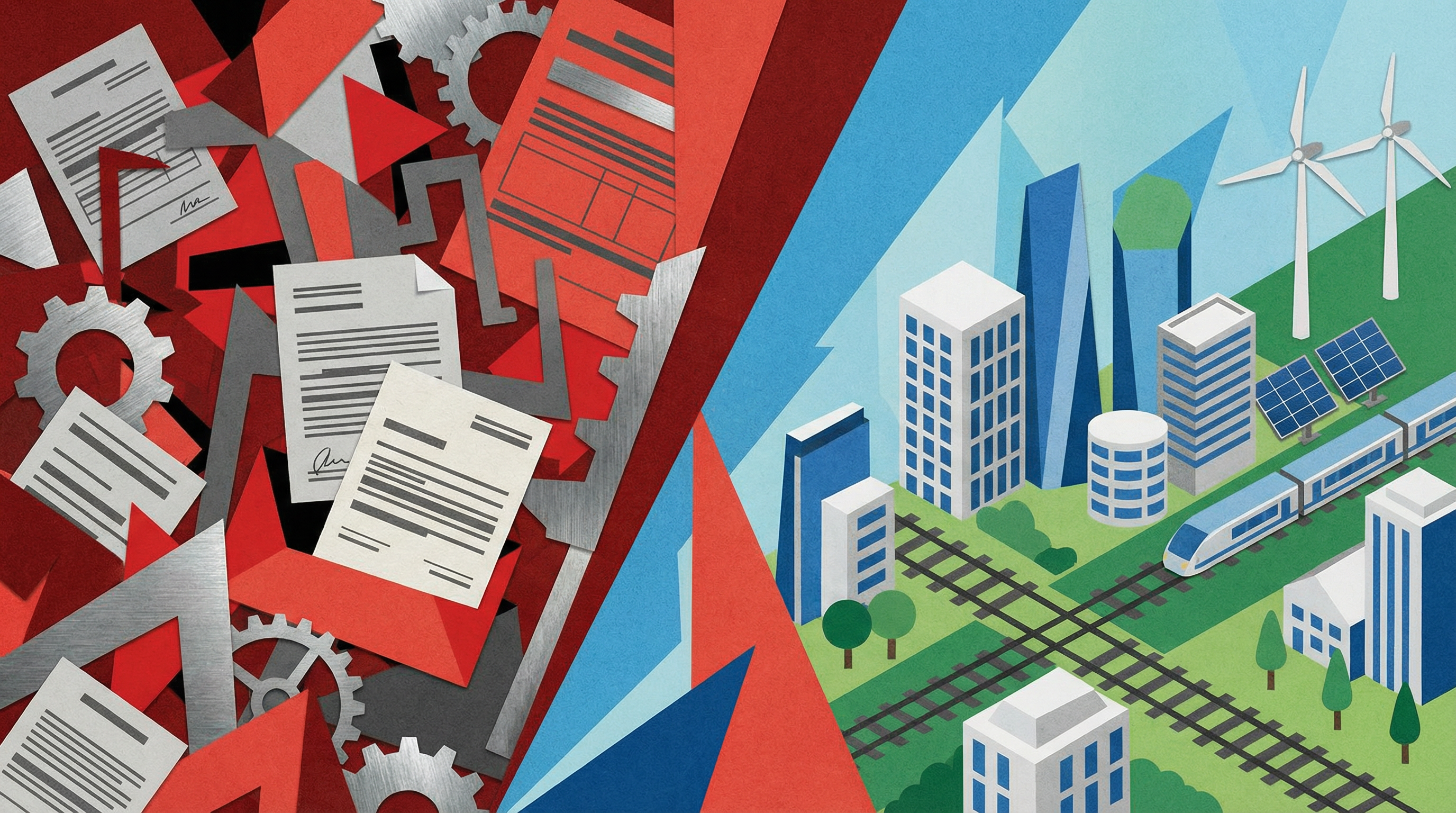
Ezra Klein is an opinion columnist for The New York Times and host of The Ezra Klein Show podcast. Derek Thompson is a staff writer at The Atlantic and author of Hit Makers (2017). Together, they published an essay in March 2025 that dominated American political debate for months. Their thesis can be summarized in one sentence: the American left has regulated so much that it no longer knows how to build. Housing, transport, energy, infrastructure: progressives have accumulated protections that prevent the production of goods most needed by working-class communities.
The Diagnosis: Scarcity is Manufactured, Not Natural
The book opens with a paradox. The United States is the richest country in the world, with a GDP of 28 trillion dollars. It possesses the technology, capital, and workforce necessary to build housing, hospitals, train lines, and solar power plants. And yet, California has a shortage of 840,000 housing units. The high-speed rail between Los Angeles and San Francisco, launched in 2008, is still not completed. The cost of the New York subway is five to ten times higher than that of comparable projects in Europe.
Klein and Thompson identify the causes of this paralysis. Zoning reserves 75% of Californian residential land for single-family homes, effectively prohibiting the construction of multi-family buildings. The CEQA (California Environmental Quality Act), adopted in 1970 to protect the environment, is used by residents to block social housing and public transport projects. Public hearings, designed to give citizens a voice, are monopolized by homeowners who refuse any densification of their neighborhood. Accessibility standards, affordable housing requirements, and appeal procedures add years and millions of dollars to each project.
The result is a system where each rule taken in isolation is defensible, but whose cumulative effect is to make construction impossible for anyone who cannot afford to pay lawyers and consultants for years.
The Thesis: Building is a Progressive Act
The central proposition of the book is that the left must relearn how to build. Klein and Thompson do not propose Reagan-era deregulation. They propose a state that produces instead of merely redistributing. Their argument: redistributing purchasing power in an economy where housing is scarce and infrastructure is insufficient only increases prices. First, supply must be increased.
They align with the economic policy of the Biden administration: the Infrastructure Investment and Jobs Act (1.2 trillion dollars), the CHIPS and Science Act (280 billion), and the Inflation Reduction Act (369 billion). These laws have injected considerable sums into the American economy. But concrete results are slow to materialize, because administrative procedures transform every dollar invested into months of delays.
Klein and Thompson propose simplifying these procedures without eliminating them. Reduce environmental review times from five years to two years. Limit the number of possible appeals against a building permit. Authorize the construction of multi-family buildings in areas currently reserved for single-family homes. Train more doctors by eliminating artificial quotas imposed by medical schools. Accelerate authorization procedures for solar and wind power plants.
The Data Supporting the Argument
The book is rich in comparative data. The extension of the Second Avenue Subway in New York cost 2.5 billion dollars per kilometer. The Grand Paris Express costs approximately 300 million euros per kilometer. The Copenhagen Metro, 200 million euros. The discrepancy is explained neither by wages nor by material costs, but by procedures.
In Austin (Texas), the elimination of minimum parking requirements and the loosening of zoning regulations led to a 7% decrease in rents between 2022 and 2025. In New Zealand, a national zoning reform adopted in 2021 increased building permits by 20% in two years. These examples show that regulatory simplification produces measurable results.
Klein and Thompson also cite China, not as a political model but as an industrial point of comparison. China has deployed 37,000 kilometers of high-speed rail lines since 2008. It installs more solar panels in one year than the United States has installed in twenty years. This execution capacity relies on a state populated by engineers, whereas the American apparatus is dominated by lawyers and procedures.
Concrete Proposals: Ten Reforms to Unblock the Machine
The book does not merely diagnose. It proposes a series of concrete reforms, the main ones being: reducing federal environmental review times from five years to two years; authorizing the construction of four- to six-story buildings in all residential areas located near public transport; eliminating minimum parking requirements for new constructions; increasing the number of medical school places by 30% in ten years; facilitating the recognition of foreign medical degrees; accelerating authorization procedures for solar and wind farms; creating a federal authority for high-voltage power line planning.
Each proposal is accompanied by an international precedent. For zoning, New Zealand. For authorization times, Denmark. For medical training, the United Kingdom. For energy, Germany. The argument is always the same: other democracies do better, with comparable protections.
Limitations and Criticisms
The book has drawn substantial criticism. The Los Angeles Review of Books criticized the authors for ignoring the question of economic power: technological monopolies, the concentration of the real estate sector, and corporate lobbying are not addressed. The Boston Review accused Klein and Thompson of proposing a conservative vision disguised as progressivism.
David Schleicher, a professor at Yale, responded to these criticisms in an article for the Niskanen Center. He argues that the abundance movement precisely targets "homeowner cartels" that use zoning to protect the value of their properties. Regulatory simplification, in this reading, is not a gift to developers: it is an attack on the interests of existing homeowners for the benefit of renters and first-time buyers.
The most pertinent criticism concerns transferability. The American system of local zoning, public hearings, and judicial appeals has no direct equivalent in Europe. In France, the housing problem is less about zoning than about available land, construction costs, and the slowness of administrative appeals. Senator Alexandre Ouizille, in an analysis for the Fondation Jean-Jaurès published in March 2026, acknowledges the book's merit but emphasizes that it is "first and foremost an American story".
The YIMBY Movement: The Grassroots Base of the Abundance Movement
Klein and Thompson's book was not born in a vacuum. It builds on an activist movement that has existed for a decade: the YIMBYs (Yes In My Backyard), opposed to the NIMBYs (Not In My Backyard) who block construction projects in their neighborhoods. The YIMBY movement began in San Francisco in 2014, when a group of tenants and young professionals started attending public zoning hearings to support construction projects instead of fighting them.
Since then, the movement has become structured. YIMBY Action, founded in 2017, is present in 25 American states. At the federal level, Senator Brian Schatz (Hawaii) introduced the YIMBY Act, a bill that would condition federal housing subsidies on local governments adopting zoning reforms. The movement has achieved concrete victories: California's SB 9 law (2021), which authorizes the division of residential parcels into two housing units, and SB 10, which facilitates the construction of small multi-family buildings near public transport.
Klein and Thompson situate their book within this dynamic. Their contribution is to give the YIMBY movement a broader intellectual foundation, extending it beyond housing to health, energy, and infrastructure. The abundance movement is, in a way, YIMBY applied to the entire economy.
What the Book Brings to the French Debate
The French translation, published by Éditions Arpa in March 2026, arrives at a time when France itself is seeking to revive housing construction. The number of new housing units started fell by 30% between 2022 and 2025, dropping below the 300,000 per year mark. The cost of the Grand Paris Express has spiraled from an initially projected 25 billion euros to over 40 billion.
Klein and Thompson do not provide solutions directly applicable to the French context. But they raise a question that the French left often avoids: why are the most progressive metropolises (Paris, Lyon, Bordeaux) also those where housing is the most expensive? Why do infrastructure projects take decades? Why is the energy transition progressing so slowly despite available funding?
Klein and Thompson's answer is that the protections accumulated since the 1970s have ended up protecting those who already have housing, a job, and a pleasant neighborhood, to the detriment of those who do not. This analysis deserves to be discussed, including in France.
The Context of the 2024 Democratic Defeat
The book cannot be read independently of its political context. In November 2024, Democrats lost the presidential election to Donald Trump, despite an objectively positive economic record: historically low unemployment, sustained growth, and increased industrial investments thanks to the IRA and CHIPS Act. Senator Alexandre Ouizille, in his analysis for the Fondation Jean-Jaurès, identifies the problem: "You don't make up for forty years of abandonment of the working and middle classes in just four years."
Klein and Thompson draw a specific lesson from this defeat: the Biden administration's massive public investments did not produce visible results quickly enough. Housing was not built faster. Prices did not decrease. Infrastructure projects remain bogged down in procedures. The problem is not a lack of funding, but the administrative machine that transforms every dollar invested into years of delays.
This analysis aligns with that of Dan Wang, author of Breakneck (2024), who attributes China's industrial success to a state populated by engineers, and American sluggishness to a society dominated by lawyers and procedures. Klein and Thompson do not go as far, but their diagnosis converges: the American state's capacity for execution has eroded.
Key Figures from the Book
Some key data summarize Klein and Thompson's argument. The housing deficit in California: 840,000 units. The cost of a meter of subway in New York: 2.5 billion dollars per kilometer. The doctor shortage in the United States by 2036: 86,000. The average authorization time for a wind farm: 4.5 years. Solar capacity installed by China in 2023: 217 GW, compared to 175 GW cumulative for the United States in twenty years. The cost of the American healthcare system: 4.5 trillion dollars per year, 17.3% of GDP. American life expectancy: 77.5 years, lower than all other G7 countries.
These figures are not disputed by the book's critics. The disagreement concerns the causes and solutions, not the diagnosis.
In Summary
Abundance is a political polemic, written in the context of the Democratic defeat of November 2024. Its strength lies in documenting, with supporting data, how well-intentioned regulations produce large-scale perverse effects. Its weakness is ignoring questions of redistribution, economic power, and institutional specificity. It is a book that asks the right questions without always providing the right answers. But the questions it raises are those that any governing left, in America as in Europe, will have to confront.
---
Bibliographic Information