Harvard's AI Education Study: An Intelligent Tutor Outperforms the Classroom in a Randomized Controlled Trial
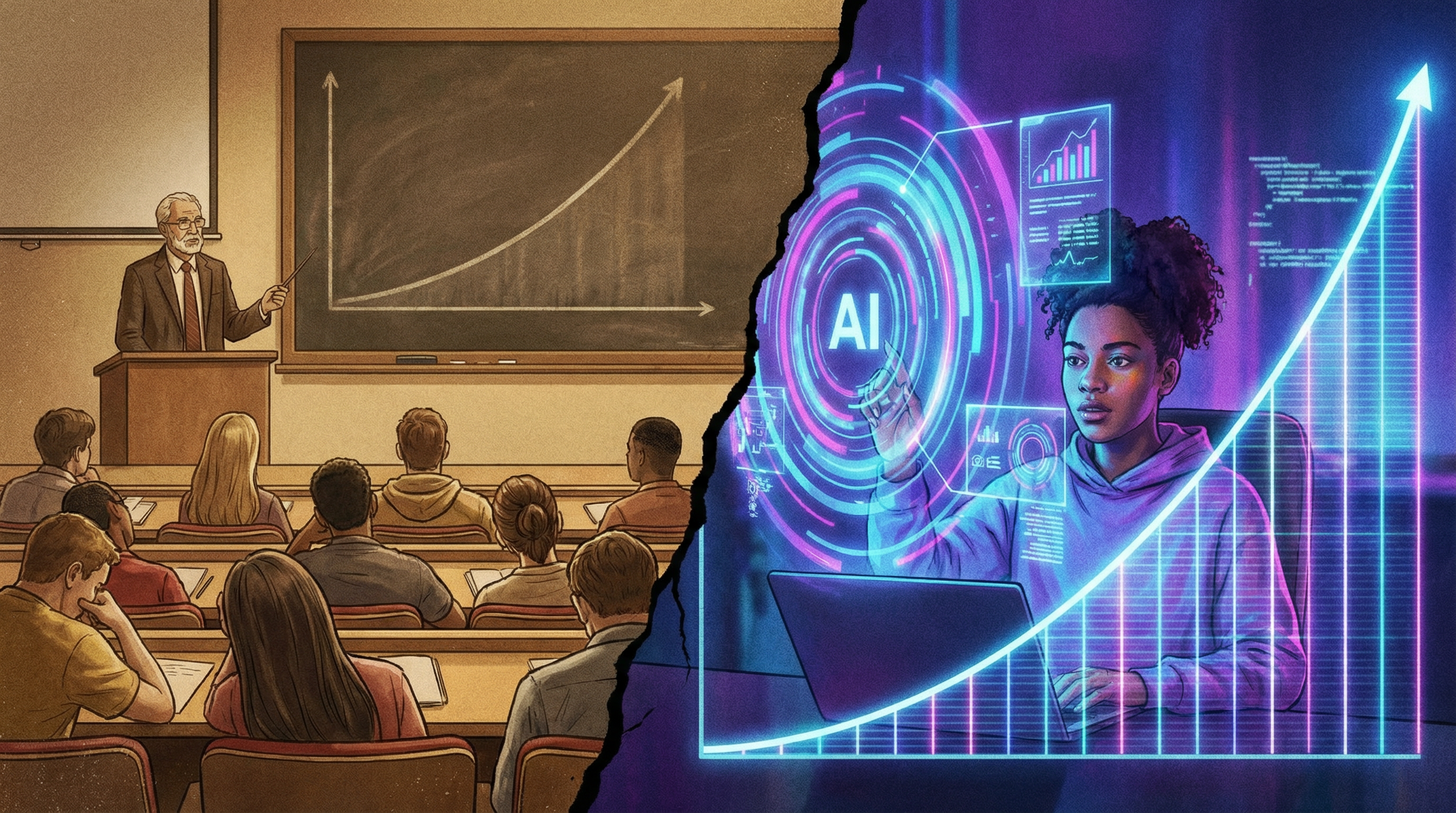
A randomized controlled trial (RCT) conducted at Harvard and published on March 5, 2026, shows that an AI tutor produces learning gains twice as high as an active classroom course — in 49 minutes instead of 60. The implications are significant, but so are the nuances.
The Protocol
The study was conducted on 800 undergraduate students at Harvard, randomly divided into two groups. The "classroom" group followed a physics course in an "active learning" format — the pedagogical format considered most effective in scientific literature, featuring interactions, Q&A, and group problem-solving. The "AI" group worked individually with an AI tutor based on GPT-4, calibrated to the same educational content.
Both groups were evaluated by a standardized test before and after the session. The AI group achieved learning gains (pre-test / post-test difference) twice as high as the classroom group. And it completed the session in 49 minutes on average, compared to 60 minutes for the course.
First Large-Scale Randomized Trial: AI Beats the Best Known Pedagogical Format
This is the first large-scale RCT comparing an AI tutor to an active classroom course in an elite university setting. Previous studies compared AI to passive lectures — an easy bar to clear. Here, the comparison is with the best known pedagogical format. And AI wins.
The result is consistent with the "2 sigma problem hypothesis" formulated by Benjamin Bloom in 1984: one-to-one tutoring produces learning gains 2 standard deviations higher than a classroom course. AI appears to replicate this effect — at a near-zero marginal cost.
Open Questions
The study focuses on a single 49-60 minute session. It says nothing about long-term learning, retention, sustained motivation, or AI's ability to develop critical thinking and autonomous thought.
The study was conducted at Harvard — on students who are already selected, motivated, and comfortable with technology. Transferability to other contexts (public high schools, developing countries, struggling students) is an open question.
The question of equity is central. If the AI tutor is more effective than the classroom, who will have access to it? Students from wealthy universities who can afford licenses, or students from underfunded public schools who would need it most? Educational AI risks amplifying existing inequalities as much as it could reduce them.
The Role of the Teacher
The study does not conclude that teachers are obsolete. It suggests that their role could evolve: less content transmission (which AI does better), more socio-emotional support, critical thinking development, and learning supervision. The teacher as a "coach" rather than a "transmitter" — an evolution that active pedagogy has advocated for decades, but which AI could make inevitable.