How Estonia Systematized Artificial Intelligence in Its Education System
# How Estonia Systematized Artificial Intelligence in Its Education System
Estonia, a Baltic nation of 1.3 million people, has become the first country in the European Union to integrate artificial intelligence into its schools in a structured, nationwide manner. Building on a cutting-edge digital infrastructure and a long-term political vision, the country is deploying a strategy aimed at preparing all its youth for 21st-century skills, in contrast to the often more fragmented approaches of its European neighbors.
The Digital Society as a Prerequisite for Educational Transformation
Estonia's lead did not come out of nowhere. It is the result of decades of strategic investment in digital technology, embodied by the "e-Estonia" program. As soon as it regained independence in 1991, the country made a radical bet on dematerialization. Today, 99% of public services are available online, from filing taxes to creating a business in minutes, including electronic voting and accessing one's digitized medical records. This digital culture, deeply embedded in the daily lives of citizens, has created an exceptionally fertile ground for the adoption of new technologies in the education sector. Estonian schools were among the first in the world to be fully connected to the Internet in the late 1990s through the pioneering "Tiger Leap" program. This initiative not only equipped schools with computers and network access but, more importantly, massively trained teachers and accustomed students to using digital tools as a natural component of their learning. The national learning platform "e-Koolikott" (e-Schoolbag) centralizes educational resources, homework, and communication between schools, students, and parents. This familiarity with technology, on the part of teachers, students, and their parents, has removed many of the cultural and technical barriers that hinder the adoption of AI in other countries. The infrastructure is in place, trust in digital technology is established, and the political will has never wavered, viewing technological education not as an expense, but as a fundamental investment in the country's sovereignty and competitiveness.
From Programming for All to AI for Everyone
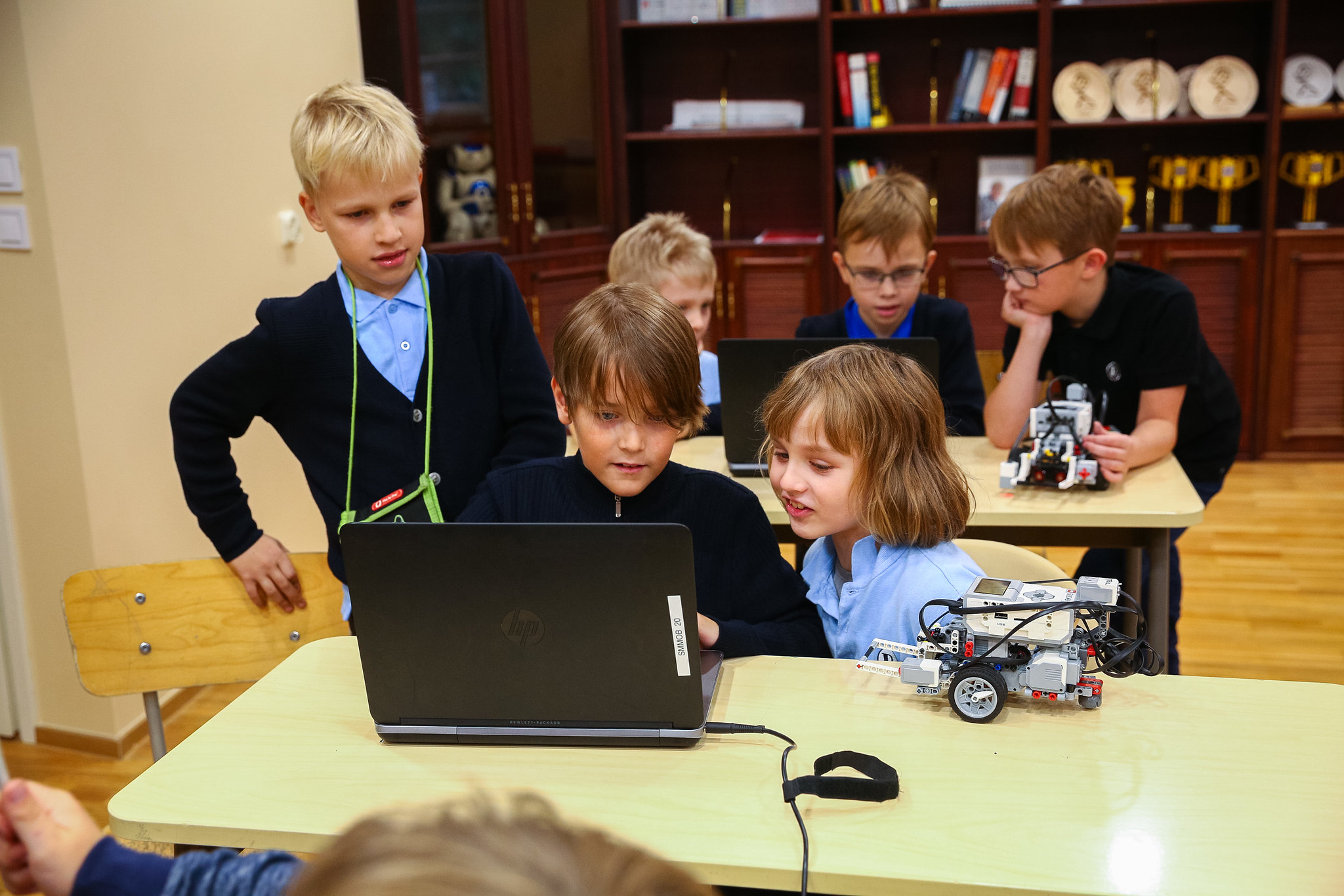
Even before artificial intelligence became a global media topic, Estonia was already laying the groundwork for an education in computational thinking. Launched in 2012, the "ProgeTiger" program introduced the teaching of programming and robotics from primary school and even kindergarten. The goal was never to turn every child into a software developer, but to instill in them a more fundamental skill: algorithmic thinking. This involves teaching students to break down a complex problem into manageable sub-parts, identify patterns, design logical solutions, and test them iteratively. In practice, the youngest children start with simple programmable robots like Bee-Bots to understand instruction sequences, while older students work on coding projects in Python or create connected objects with microcontrollers. ProgeTiger was designed as a complete ecosystem, providing schools with free robotics kits, textbooks, software platforms, and, crucially, a continuing education program for teachers. Thousands of teachers have thus been trained, creating a teaching body capable not only of using the tools but also of understanding their underlying logic and adapting it to their subject, whether in mathematics, arts, or history. This program laid the cognitive and pedagogical foundations on which the national AI strategy could be built. By familiarizing students with the basic concepts of computer science, Estonia has ensured that the introduction of AI would not be perceived as a magical black box, but as the logical extension of an already well-established learning process.
"AI Leap": A Nationwide Generalization
The next stage of this ambition is the "AI Leap 2025" program. This initiative, with a substantial budget, aims to generalize access to and use of AI-based pedagogical tools throughout the secondary and vocational school system. Starting in the 2025 school year, an initial contingent of 20,000 high school students and 3,000 of their teachers will have access to a suite of personalized applications. The goal is to reach 58,000 students and 5,000 teachers by 2027, thus covering almost the entire relevant school population. The program does more than just provide software licenses. It finances the development of specific tools adapted to Estonian school curricula, in partnership with local and international technology companies, including giants like OpenAI and Anthropic. Concrete applications include intelligent tutors for learning languages or mathematics that adapt in real-time to the student's level, writing assistants that provide constructive feedback on the structure and argumentation of essays, and complex simulators for scientific subjects allowing for virtual experiments. A major component of the program is teacher training. Far from being limited to simple technical training on the tools, the training emphasizes the pedagogical integration of AI: how to use it to differentiate teaching, to automate repetitive tasks like grading multiple-choice homework, and to devote more time to individualized support and mentoring of students. The Estonian approach is to make the teacher an "orchestra conductor" who uses AI as a powerful instrument to enrich their practice, not as a substitute.
Results That Validate a Long-Term Strategy
This strategy of massive investment in education and technology is producing measurable and internationally recognized results. For several years, Estonia has ranked at the top of the OECD's PISA (Programme for International Student Assessment) surveys, which assess the skills of 15-year-old students in reading, mathematics, and science. The country outperforms almost all other European nations, including reputable systems like Finland. In 2022, Estonian students ranked first in Europe in science and reading, and second in mathematics, placing them on par with top Asian nations like Singapore or Japan. These exceptional performances cannot be attributed to a single factor, but experts agree that the early and thoughtful integration of digital technology in learning has played a significant role. The Estonian education system, which values autonomy, responsibility, and equal access, has cultivated a problem-solving ability in students, skills directly encouraged by programs like ProgeTiger. Furthermore, the use of adaptive learning tools allows for better catering to the individual needs of each student, whether they are struggling or ahead, thus contributing to overall excellence and a reduction in educational inequalities, another strong point of the Estonian system. These PISA results are not an end in themselves for Estonian leaders, but they serve as external validation of their approach, reinforcing the conviction that a technology-oriented education is the best way to prepare tomorrow's citizens for a rapidly changing global economy.
An Approach That Challenges Other European Models
The Estonian model stands in sharp contrast to the approaches adopted by other European countries, such as France. While Estonia has implemented a national, centralized, and long-term funded strategy, many other countries are advancing in a more dispersed manner, often at the mercy of local initiatives or pilot projects with no follow-up. In France, for example, initiatives like the AI4T (Artificial Intelligence for and by Teachers) project, co-financed by the European Union, do aim to train teachers in AI. However, these projects often rely on volunteering and lack the systemic nature of the Estonian deployment. It is estimated that only 14% of French teachers have received some form of training in artificial intelligence, compared to a target of almost the entire teaching body in Estonia. The difference is not only quantitative, it is also philosophical. Estonia has made a strong political choice: to consider AI proficiency as a fundamental 21st-century skill, on par with reading, writing, and arithmetic. Elsewhere, AI is often still perceived as an optional tool, a specialist subject, or even a potential threat to be wary of, leading to hesitant educational policies. This divergence of vision could create significant skills gaps between future generations of Europeans. Estonia is not just seeking to optimize its education system; it is positioning itself to attract the talent and businesses of the new economy by training a workforce natively competent with artificial intelligence tools. The country thus offers a fascinating case study of how a small nation can, through a clear vision and rigorous execution, place itself at the forefront of a major technological transformation.
Training Enlightened Citizens in the Age of AI
Beyond the simple acquisition of technical skills, Estonia's ambition is deeper: to train citizens capable of understanding, using, and criticizing the artificial intelligence systems that will increasingly shape their environment. The school curricula include not only modules on programming or the use of applications, but also courses on the ethics of AI, the detection of biases in algorithms, and the protection of personal data. The goal is to demystify AI and give young people the keys to become conscious actors and not just passive consumers of this technology. By understanding how a recommendation algorithm on social media can create filter bubbles, or how a language model can generate false but plausible information ("hallucinations"), students are better equipped to navigate a complex digital world. This education in critical thinking is considered a pillar of the country's democratic resilience. In a tense geopolitical context, with a Russian neighbor quick to use disinformation, training a population educated in the principles of AI is a form of civil defense. The school is therefore not only a place for training the future workforce, but the crucible of an enlightened digital citizenship, capable of taking part in collective decisions on one of the most structuring transformations of our time. The Estonian government is betting that this civic competence will be just as valuable as technical competence in ensuring the country's prosperity and security in the 21st century. The stakes are high: it is a matter of ensuring that AI remains a tool at the service of humans and democratic societies, and not the other way around. Estonia, through its holistic and audacious approach, offers a possible path to achieve this.
Sources
- [1] e-Estonia. AI Leap 2025, e-estonia.com
- [2] Education Estonia. The ProgeTiger programme, educationestonia.org
- [3] Institut francais d'Estonie. Teaching and learning FLE with AI
- [4] France Education International. AI4T - Artificial Intelligence for and by teachers
- [5] OECD. PISA Dashboard