Has CERN Unlocked the Secrets of the Force That Constitutes Us?
_Title: Has CERN Unlocked the Secrets of the Force That Constitutes Us?_
For over half a century, the Standard Model of particle physics has reigned supreme over our understanding of the infinitely small. This theory remarkably describes the elementary building blocks of matter and three of the four fundamental forces that govern them: electromagnetism, the weak interaction, and the strong interaction. Yet, despite its brilliant successes, such as the prediction and discovery of the Higgs boson in 2012, the Standard Model remains an unfinished work. It does not incorporate gravity, and provides no explanation for the nature of dark matter or dark energy, which nonetheless constitute 95% of the cosmos. At the heart of this theoretical edifice, the strong interaction, the most powerful of nature's forces, plays a central role. It is what ensures the cohesion of protons and neutrons by confining their constituents, quarks, and what binds these same protons and neutrons to form atomic nuclei. Without it, matter as we know it, from the atoms that compose us to the stars that shine, could not exist. Understanding its innermost workings is therefore an essential quest for physicists. At CERN's Large Hadron Collider (LHC), recent experiments have begun to unveil some of its most complex aspects, refining our knowledge of this pillar of reality.
The LHC, a machine to recreate the first moments of the Universe
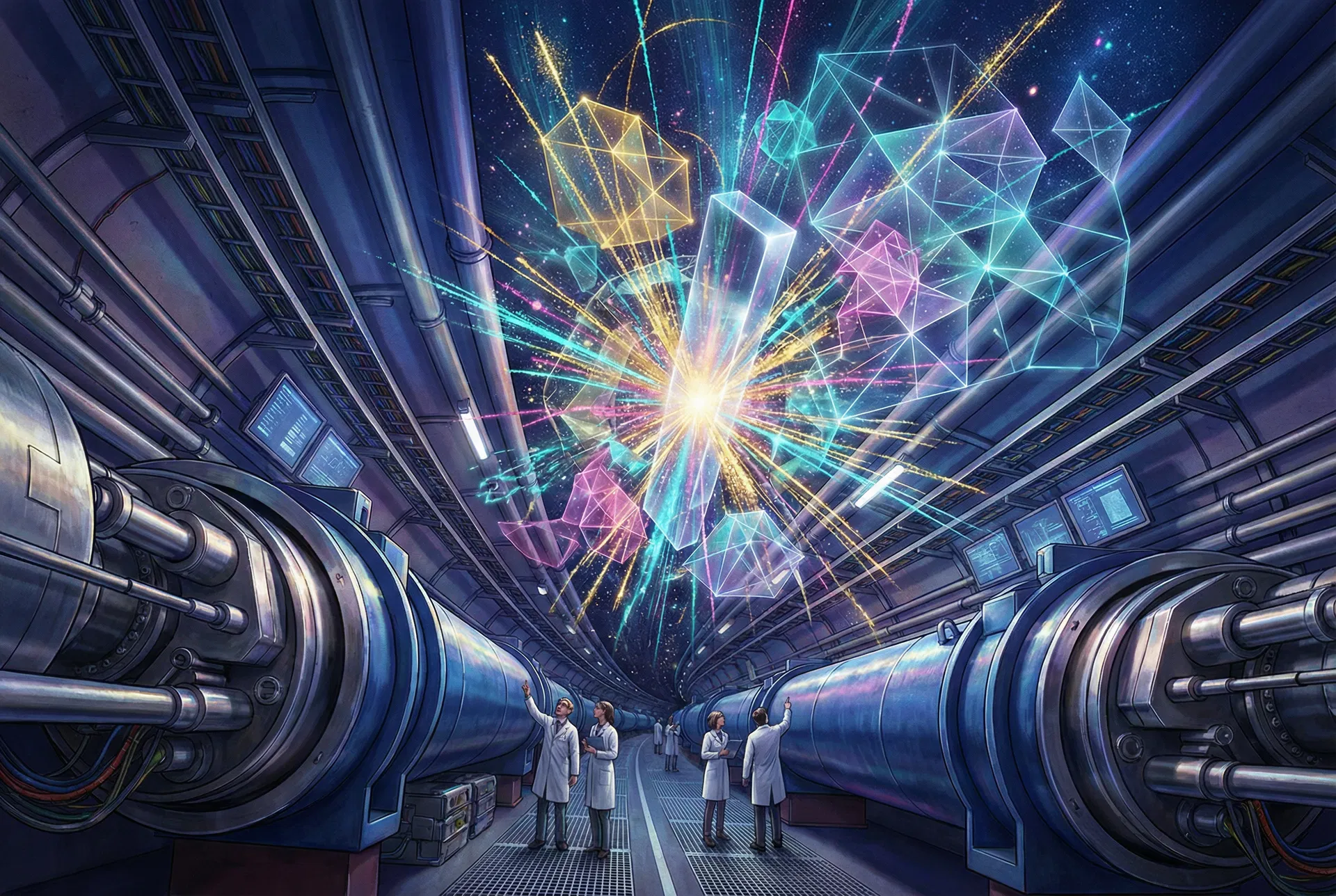
To probe matter to its limits, physicists have built tools of extraordinary dimensions and performance. The Large Hadron Collider is the largest and most powerful of them. Located in a circular tunnel 27 kilometers in circumference, a hundred meters underground on the Franco-Swiss border, the LHC accelerates beams of protons or heavy ions at a dizzying speed, 99.9999991% of the speed of light. These particles, launched in opposite directions, collide head-on at four precise points around the ring, where gigantic detectors, true cathedrals of technology, are installed: ATLAS, CMS, ALICE, and LHCb. ATLAS and CMS are so-called general-purpose experiments, designed to explore the widest possible spectrum of physical phenomena, and it was they who co-discovered the Higgs boson. ALICE (A Large Ion Collider Experiment) specializes in the study of heavy ion collisions to recreate and analyze the quark-gluon plasma, a state of matter that prevailed a few microseconds after the Big Bang. Finally, LHCb (Large Hadron Collider beauty) focuses on the study of
“beauty” (or bottom) quarks, particles whose behavior could reveal flaws in the Standard Model. By recreating colossal energy densities, the LHC acts as a time machine, offering a unique window into the fundamental laws of nature.
90% of light nuclei form after the initial collision
A puzzle that long intrigued physicists was the survival of light atomic nuclei, such as deuterons (one proton and one neutron), in the extremely hot and dense environment created by heavy ion collisions at the LHC. The temperatures reached, hundreds of thousands of times higher than those at the center of the Sun, should theoretically have dissociated these nuclei. In late 2025, the ALICE collaboration announced that they had solved this mystery in a publication in the journal Nature. The study revealed that nearly 90% of deuterons do not originate directly from the initial collision. Instead, they form through a delayed fusion process. An unstable particle, the Delta (Δ) resonance, decays into a pion and a nucleon (proton or neutron). This nucleon, emitted a small distance from the collision point, is in a slightly cooler environment, allowing it to fuse with another nearby nucleon to form a stable deuteron. This discovery has profound implications. As Marco van Leeuwen, ALICE spokesperson, pointed out, it provides essential data for the next generation of theoretical models. These models are crucial for interpreting data in astrophysics, particularly for the search for dark matter signals, as the production of light nuclei and antinuclei in space could follow similar processes.
A new doubly charmed baryon, 4 times heavier than the proton
In March 2026, the LHCb collaboration announced the discovery of a new exotic particle, the Xi-cc-plus (Ξcc⁺) baryon. A baryon is a particle composed of three quarks, the proton being the best-known example (two up quarks, one down quark). The new particle is much more singular: it is composed of two heavy charm quarks and one light down quark. This composition gives it a mass about four times greater than that of the proton. This discovery solves a 20-year-old enigma, as clues of such a particle were observed at Fermilab in 2002 but with a mass that did not match predictions. The precise measurements by LHCb, with a statistical significance of seven sigma, confirm its existence and its expected mass. It is the second doubly heavy baryon discovered, after its partner the Xi-cc-plus-plus (two charm quarks, one up quark) identified in 2017. Comparing these two particles is a unique laboratory for testing quantum chromodynamics (QCD), the theory of the strong force. Theorists can thus calculate the properties of these particles with great precision and compare them with experimental measurements. The fact that the new baryon decays six times faster than its predecessor, for example, is a powerful test for models, as this difference in lifetime is due to complex quantum effects related to the strong interaction.
Probing 3-body interactions at the femtometer scale
In parallel with the discovery of new particles, new analysis methods are making it possible to explore the strong force with unprecedented precision. A publication in Physical Review X in September 2024 by the ALICE collaboration presented a new experimental method for studying the dynamics of three-body nuclear systems. Using a technique called femtoscopy, which measures momentum correlations between produced particles, researchers were able to probe interactions between a deuteron and a third hadron at distances of approximately 2 femtometers (2 x 10⁻¹⁵ meters). The analysis showed that to correctly describe proton-deuteron correlations, a complete three-body theoretical model is essential. This approach opens a promising path for the study of three-body forces involving particles with strange or charmed quarks. These studies are fundamental to understanding the structure of neutron stars, cosmic objects where matter is so dense that protons and electrons fuse to form neutrons, and where strange particles could appear.
Beyond knowledge: technological and societal spin-offs
While CERN’s primary mission is fundamental research, the technological demands it imposes have major repercussions in many areas. To build and operate the LHC, thousands of engineers and technicians had to push the limits of technology in fields as varied as cryogenics, vacuum, superconductivity, electronics, and computing. The LHC’s superconducting magnets, which generate magnetic fields 100,000 times more intense than Earth’s to bend the trajectory of protons, are an engineering feat. Technologies developed for the LHC find applications in the medical field, particularly for magnetic resonance imaging (MRI). Similarly, particle acceleration techniques are at the base of hadron therapy, a form of high-precision radiotherapy that uses proton or carbon ion beams to destroy cancerous tumors while sparing healthy tissues. CERN is also the birthplace of the World Wide Web, invented in 1989 by Tim Berners-Lee to meet the need for information sharing among scientists worldwide. Today, to manage the colossal volume of data generated by the LHC (more than 30 petabytes per year), CERN has developed the Computing Grid, a global network of computers that prefigures cloud computing. These examples illustrate how the quest for fundamental knowledge is a powerful driver of innovation.
The future is being prepared with the High-Luminosity LHC and the FCC
These discoveries are part of an ambitious roadmap. The next major step is the High-Luminosity LHC (HL-LHC), an upgraded version of the accelerator expected to come into service around 2029. The HL-LHC will increase the number of collisions by a factor of 5 to 7, allowing ten times more data to be collected by the end of the 2030s. This avalanche of data will make it possible to measure the properties of known particles, such as the Higgs boson, with unparalleled precision and to increase the potential for discovering new particles or new phenomena. But physicists are already looking further ahead. The Future Circular Collider (FCC) project is under study. It would involve a 91 km circumference tunnel, which could first house an electron-positron collider (FCC-ee) and then, in the longer term, a proton collider (FCC-hh) reaching an energy of 100 TeV, seven times more than the LHC. Such a project would push the boundaries of knowledge far beyond what is possible today. Recent discoveries, by refining our understanding of the strong force, are essential for designing these future machines and interpreting the data they will produce. Each piece of the puzzle added today helps to draw the map of tomorrow’s unknown territory.
Recent discoveries at CERN, whether concerning the formation of light nuclei, the identification of new particles, or the development of innovative analysis methods, converge towards a common goal: refining our knowledge of the Standard Model of particle physics. Each result, by resolving an ambiguity or confirming a prediction, adds another piece to the matter puzzle. These advances are not mere technical feats; they open concrete perspectives for other fields, such as cosmology and the search for dark matter. The path towards a unified theory of matter is still long, but the giant strides recently made at the LHC are undeniably bringing us closer. Particle physics is a science of patience and precision, and every new piece of data, every new particle, is a promise of even more fundamental discoveries to come. With an annual budget of over 1.2 billion Swiss francs, funded by 23 member states, CERN is an example of international scientific collaboration. It employs nearly 2,600 people and hosts over 13,000 scientists from around the world. This massive investment in fundamental research, although costly, is essential for pushing the boundaries of human knowledge and developing the technologies of tomorrow.