The Sodium-Ion Battery: The Lab-Grown Alternative to Lithium
| --- | --- | --- | --- | |
|---|---|---|---|---|
| Energy Density (Wh/kg) | 160 - 180 | 120 - 150 | 160 - 200 | 220 - 280 |
| Lifespan (cycles) | 4,000 - 6,000 | > 10,000 | 3,000 - 6,000 | 1,000 - 3,000 |
| Cold Performance (-20°C) | > 90% capacity | > 90% capacity | 60 - 70% capacity | 70 - 80% capacity |
| Safety (Thermal Runaway) | Very High | Very High | High | Medium |
| Projected Cost ($/kWh) | ~40 | ~50 | ~60 | ~80 |
| Critical Raw Materials | Manganese, (Nickel) | Manganese, Iron | Lithium, Graphite | Lithium, Cobalt, Nickel, Graphite |
Sources: Data compiled from CATL, Tiamat, IEA, and market analyses. [2] [3]
A Market in Full Structuring
Although still nascent, the sodium-ion battery market is experiencing exponential growth. Valued at $1.83 billion in 2025, it is expected to reach over $7 billion by 2034, with an average annual growth rate of over 15% [4]. The Asia-Pacific region, driven by China, largely dominates, accounting for over 60% of the market.
The targeted applications are strategic and complementary to those of lithium-ion:
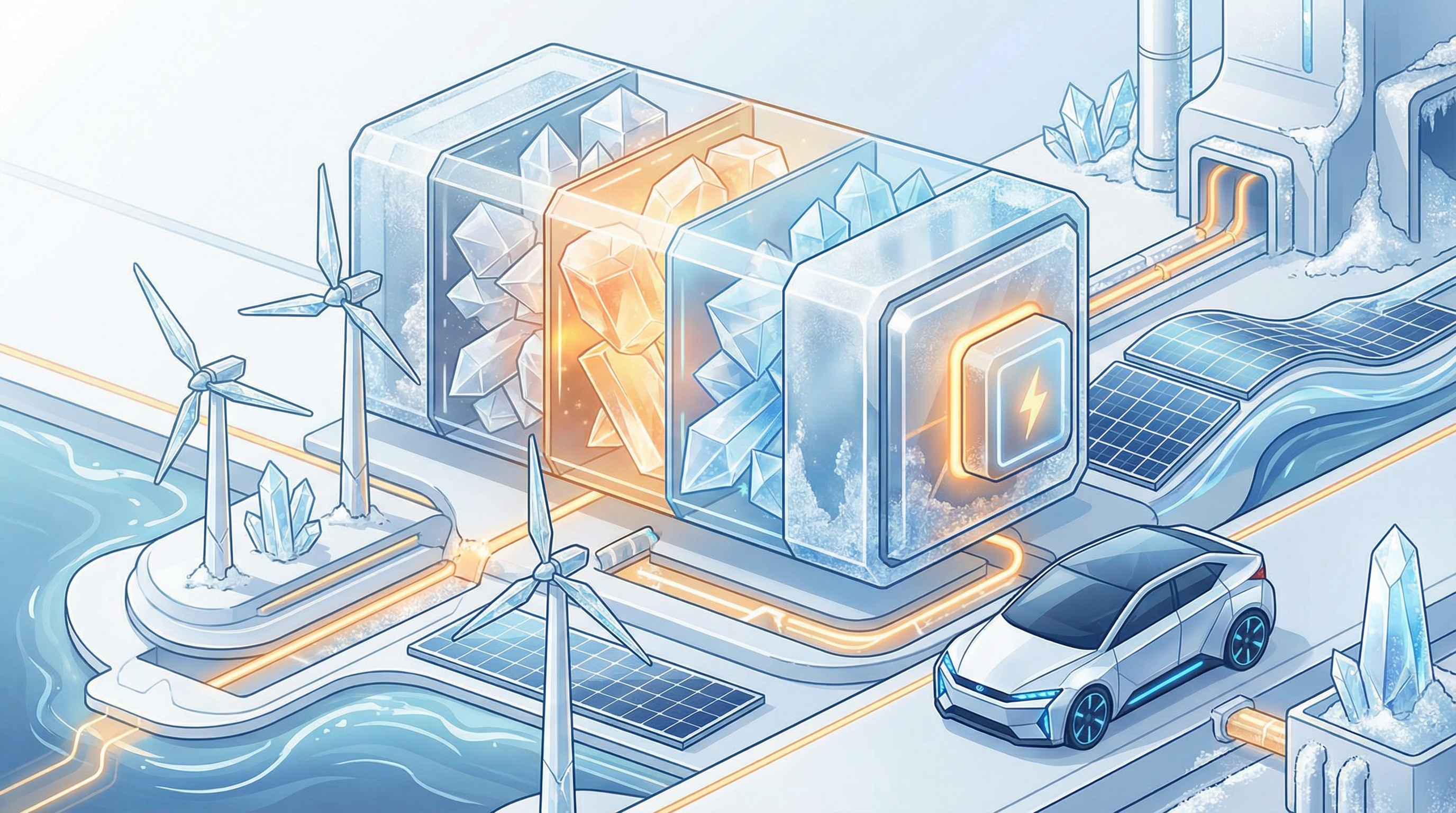
Stationary Energy Storage*: This is the most promising outlet. The exceptional lifespan (especially for PBA chemistries), safety, and low cost of sodium-ion batteries make them an ideal solution for storing the intermittent energy from solar and wind farms. A cost below $50/kWh is considered the threshold that makes battery storage more competitive than peaker gas plants.
Entry-Level Electric Vehicles*: For small city cars and low-cost vehicles where range is not the primary criterion, sodium-ion offers an economical alternative to LFP. The first mass-produced car equipped, the Changan Nevo A06, is expected in mid-2026.
Cold Climate Applications*: The ability of sodium-ion batteries to operate without significant performance loss down to -40°C opens up markets that have been difficult to access for lithium-ion, such as in Nordic countries, Canada, or Russia.
China has taken a considerable lead, with players like CATL and BYD investing heavily. Europe is attempting to position itself with initiatives like Tiamat in France, which is building a gigafactory in Dunkirk, or Northvolt in Sweden. The United States is relying on players like Natron Energy, specializing in high-power applications.
30% Lower Energy Density Than Lithium-Ion: A Technical Ceiling
Despite this momentum, several technical and economic obstacles remain before sodium-ion can fully establish itself. The main challenge is its lower energy density compared to lithium-ion batteries, particularly NMC (Nickel Manganese Cobalt) chemistries that dominate the long-range electric vehicle market. With current values peaking around 175-180 Wh/kg, compared to over 250 Wh/kg for NMC, sodium-ion cannot compete in the premium segment. Its application field remains, for the moment, that of stationary applications and entry-level mobility, where cost and durability take precedence over pure performance.
Another technical challenge lies in the stability of electrode materials. The sodium ion, being larger than the lithium ion, causes greater volume changes in the cathode and anode materials during charge and discharge cycles. This mechanical stress can lead to micro-cracks and faster performance degradation if the materials are not specifically designed to withstand it. Research into hard carbons with optimized microstructure or cathodes with a more stable crystal structure, such as Prussian blues, is therefore crucial to ensure the promised longevity of several thousand cycles.
The development of suitable electrolytes is also a major issue. The electrolyte, the liquid medium that transports ions between the electrodes, must be chemically stable and offer good ionic conductivity. Electrolytes developed for lithium-ion are not directly transferable. The higher reactivity of the sodium ion requires finding specific formulations that avoid parasitic reactions and the formation of an unstable solid-electrolyte interphase (SEI) on the anode, a phenomenon that consumes ions and reduces battery life.
Finally, the target cost of $40/kWh is an ambitious projection that will depend on economies of scale. The first commercial units are priced closer to $50 to $70/kWh. Achieving this threshold, which would make sodium-ion ultra-competitive, will require massive adoption to justify investments in gigantic production lines. Dependence on patents and know-how, particularly Chinese, partly replicates the pattern observed in solar photovoltaics. Europe and the United States will need to invest heavily in R&D and production capacity to avoid becoming mere importers.
The Challenge of Recycling and Sustainability
One of the strong arguments for sodium-ion is its promise of sustainability, based on the abundance of its primary raw material. However, a battery is a complex assembly of many components, and its true sustainability must be assessed over its entire life cycle, including recycling. Sodium-ion battery recycling is still in its early stages, but it presents specific challenges and opportunities.
Unlike lithium-ion batteries, whose recycling is partly driven by the economic value of metals like cobalt and nickel, sodium-ion batteries contain lower-value materials. The absence of lithium, cobalt, and graphite, and their replacement by sodium, iron, manganese, and hard carbon, makes the economic model for recycling more difficult to establish. There is no "treasure" to recover that would solely justify the cost of the process.
The recycling processes considered are similar to those for lithium-ion: pyrometallurgy (grinding and high-temperature melting) and hydrometallurgy (selective chemical dissolution). Hydrometallurgy appears more promising for sodium-ion, as it allows for the recovery of cathode materials with higher purity, potentially for direct reuse in the manufacturing of new batteries (closed-loop recycling). Research is underway to develop less energy-intensive processes using less harmful solvents.
A notable advantage of sodium-ion is the use of aluminum current collectors for both electrodes (anode and cathode), whereas lithium-ion batteries require copper, which is more expensive and heavier, for the anode. This uniformity simplifies material sorting during recycling. Furthermore, sodium-ion batteries can be fully discharged down to 0 volts without risk of damaging the electrodes, making them much safer to transport and dismantle than lithium-ion batteries, which retain a dangerous residual charge.
The long-term viability of the sodium-ion sector will therefore depend on the establishment of an efficient recycling ecosystem, potentially supported by regulations (such as "extended producer responsibility") rather than by economic profitability alone. The challenge is to prove that this technology is not only cheaper to produce but also cleaner at the end of its life.
Salt is Everywhere: A Battery Reducing Dependence on Chinese Lithium
The industrial emergence of the sodium-ion battery is a major development that could reshuffle the cards of energy geopolitics. By offering a credible path to diversify the energy storage technology mix, it reduces strategic dependence on lithium, whose supply chain is currently a major point of friction between China and the West. The possibility of producing batteries from salt, a universally distributed resource, could "democratize" access to energy storage and allow many countries to develop greater energy sovereignty.
For stationary storage, sodium-ion could unlock massive investments in renewable energy by solving the problem of their intermittency at a finally competitive cost. This would accelerate the decarbonization of electricity grids and reduce dependence on fossil fuels, particularly natural gas used in peaker plants.
By relying on such a common resource, this technology embodies a form of cutting-edge "low-tech": a robust, economical, and resilient solution, not to replace the most high-performance technologies, but to accomplish the essential work where it is most relevant. It is a strategic insurance against the volatility of metal markets and an opportunity to reshore part of the battery value chain, provided that the technology and industrialization are mastered.
Research continues to explore new frontiers. One of the most promising is the development of solid-state sodium-ion batteries. By replacing the liquid electrolyte with a solid material (a polymer or a ceramic), these batteries could offer even greater safety (no risk of leakage or fire) and potentially higher energy densities. Although this technology is still in the laboratory stage, it represents the next possible evolution, promising to combine the low cost of sodium with the performance and safety of all-solid-state batteries.
---
Sources
- https://en.wikipedia.org/wiki/Sodium-ion_battery
- _blank
- noopener
- https://xpert.digital/fr/batterie-au-sodium/
- _blank
- noopener
- The sodium battery: CATL Naxtra and the energy storage revolution.
- https://www.iea.org/commentaries/sodium-ion-battery-momentum-grows-but-challenges-remain
- _blank
- noopener
- https://www.fortunebusinessinsights.com/fr/industry-reports/sodium-ion-battery-market-101301
- _blank
- noopener
- https://www.tiamat-energy.com/
- _blank
- noopener
- Gigafactory Dunkirk.