Artificial Intelligence in French Education: A Deployment Between Lag and Acceleration
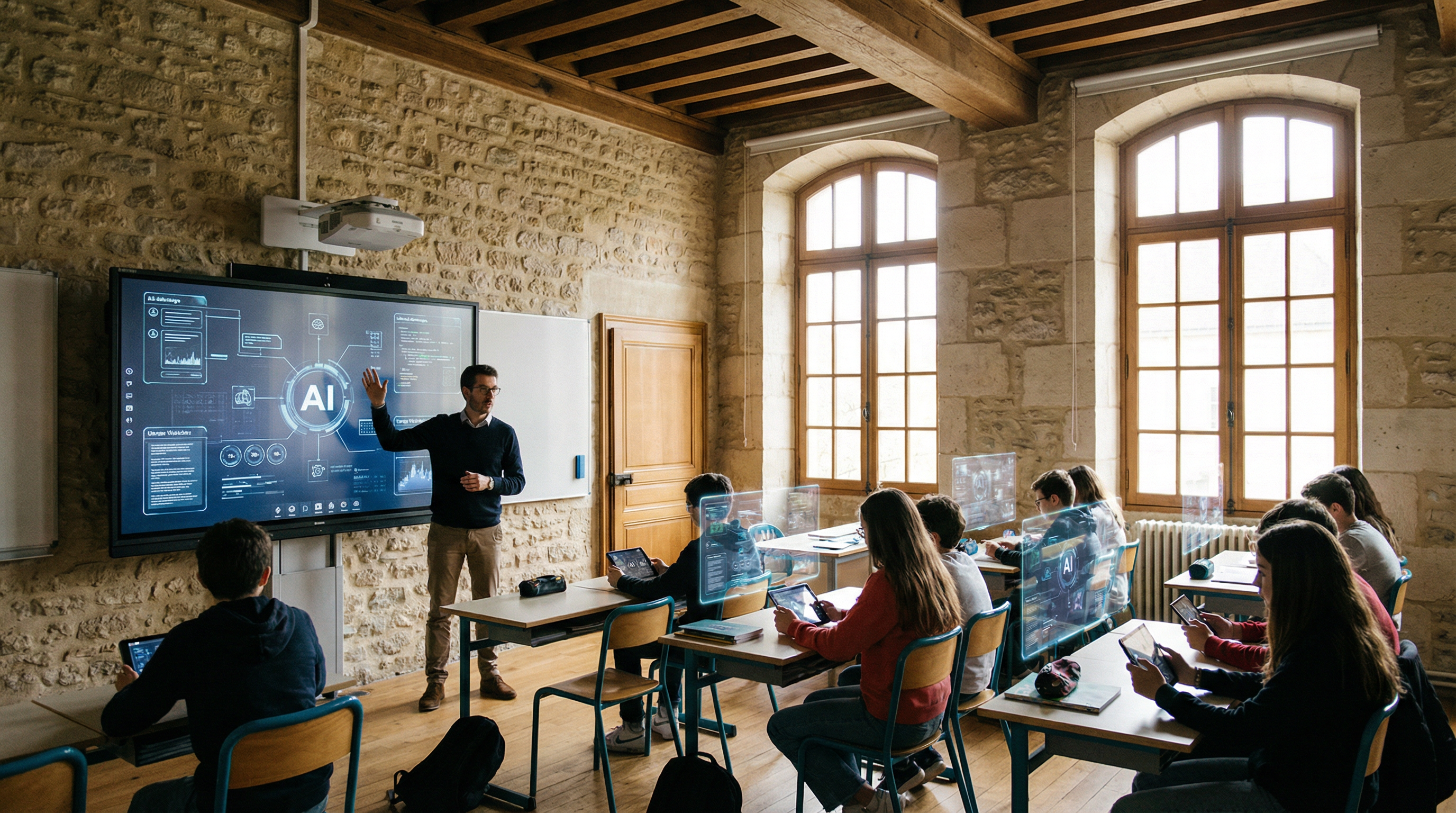
A Lag Due to Lack of Training and Equipment
The OECD's TALIS 2024 report reveals a significant gap between France and its peers. Only 14% of French lower secondary teachers report using AI in their work, compared to 36% on average in OECD countries. This lag does not reflect a lack of interest. It reveals a lack of preparation and resources.
Several factors explain this gap. Initial teacher training in France integrates few advanced digital tools. Computer equipment in schools is often insufficient or outdated. And the professional culture of the teaching corps, attached to pedagogical autonomy, can make the adoption of new tools slower.
---
The Government Plan: AI for Schools
In response to this finding, the French government launched a plan in 2025 to integrate AI into the education system. This plan has several axes: teacher training, the development of adapted pedagogical tools, and the establishment of an ethical framework for the use of AI in the classroom.
Teacher training is the first challenge. The plan aims to train 100,000 teachers in AI by 2027. This ambition faces practical obstacles: time available for continuing education is limited, specialized trainers are rare, and needs vary considerably by subject and grade level.
---
Pedagogical Uses of AI
Teachers who already use AI in their professional practice do so primarily to prepare their lessons, generate differentiated exercises, or grade work. These uses remain mostly invisible to students.
Classroom uses are rarer and more controversial. The question of students using AI to write essays or solve problems divides the teaching corps. Some see it as an opportunity to learn to use new tools. Others fear it will harm the development of fundamental skills.
---
Ethical and Pedagogical Issues
The integration of AI into education raises important ethical questions. The protection of students' personal data is a major concern. AI tools used in the classroom collect information about students' learning behaviors, difficulties, and progress. The question of ownership and use of this data must be regulated.
The question of equity is also central. If AI tools are effective at personalizing learning, they risk widening inequalities between well-equipped schools and those that are not. Access to digital tools remains unequal in France, with significant disparities between urban and rural areas, and between public and private institutions.
---
An Opportunity to Seize
Despite these challenges, AI offers real opportunities to improve the quality of teaching. Personalized learning, adaptation to the rhythms and needs of each student, support for teachers in administrative tasks: these potential contributions are significant.
France has the intellectual and institutional resources to succeed in this transition. But it must invest massively in teacher training, digital infrastructure, and the development of pedagogical tools adapted to the French context. The current lag is not inevitable. It is a challenge to be met with ambition and method.
Sources
- [1] OECD, TALIS 2024 Report, oecd.org
- [2] French Ministry of National Education, AI for Schools Plan 2025, education.gouv.fr
- [3] National Digital Council, Report on AI in Education, 2025